Airlines, Shipping, Railways, and Logistics: Thailand's Aspirations to Become ASEAN's Transportation Hub (Performance in 2017)
When Thailand announced its ambition to become the transportation hub of ASEAN, before that day arrives, TerraBKK Research invites everyone to look back at the more than 20 public companies listed on the stock exchange. We will categorize them into four major groups: Airlines, Shipping, Railways, and Logistics. The information covers business performance over the past period, including revenue and net profit figures, as well as financial ratios such as ROE, ROA, and NPM. The details are as follows:
Who has the highest revenue in Airlines, Shipping, Railways, and Logistics?
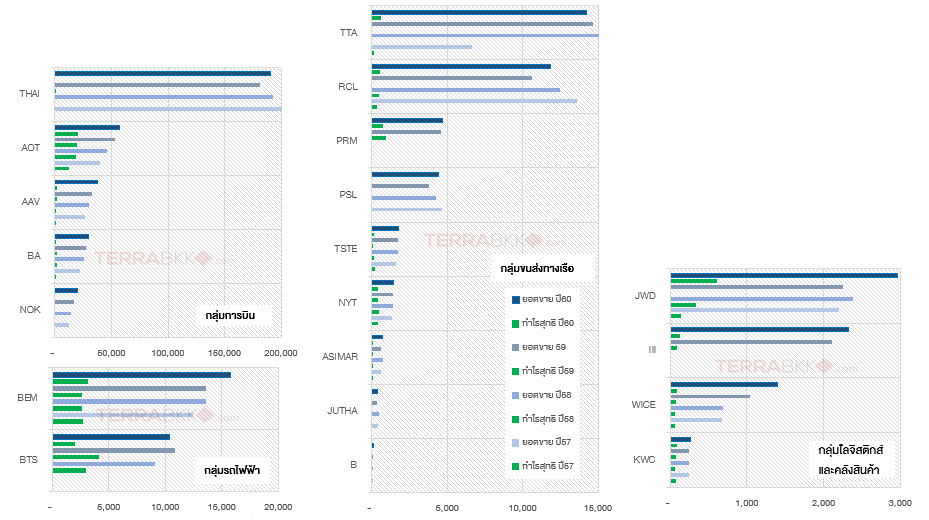
Opening the discussion on the four transportation groups in Thailand, the overall performance shows that the air transport sector has relatively good revenue compared to the shipping, railway, and logistics sectors. The public company with the highest revenue, reaching over 100 billion baht, is Thai Airways (THAI) at 190 billion baht, a 5% increase from the previous year. Following closely are Airports of Thailand (AOT) at 56.7 billion baht and Asia Aviation (AAV) at 37.2 billion baht. The next highest revenue group is the railway sector, consisting of two major players: Bangkok Expressway and Metro (BEM), which generated over several billion baht more than BTS Group Holdings (BTS) with revenues of 15.8 billion baht and 10.4 billion baht, respectively. Next is the shipping sector, which has a wide revenue range from hundreds of millions to billions, but only two companies reached the ten billion baht level: Thoresen Thai Agencies (TTA) at 14.2 billion baht and RCL at 11.8 billion baht. Finally, the logistics sector, a rising newcomer in the Thai stock market, shows promising performance, with the company generating the highest revenue in this group being JWD InfoLogistics (JWD) at 2.96 billion baht, a 31.6% increase from the previous year.
Who has the highest net profit in Airlines, Shipping, Railways, and Logistics?
Surprisingly, Thai Airways (THAI), which has a revenue level of over 100 billion baht, reported a net loss of over 2.1 billion baht. The main reasons include a 10.8% increase in aircraft fuel costs, a 19.3% rise in selling and advertising expenses, as well as losses from holding shares in Nok Air amounting to 429 million baht and foreign exchange losses of 1.58 billion baht. This led to Airports of Thailand (AOT) being the highest net profit winner among all transportation sectors in Thailand, with a figure of 20.7 billion baht. Following are Asia Aviation (AAV) at 1.47 billion baht and two railway companies: Bangkok Expressway and Metro (BEM) at 3.12 billion baht and BTS Group Holdings (BTS) at 2.00 billion baht. The shipping and logistics sectors have net profits in the hundreds of millions, with the highest in shipping being Prima Marine (PRM) at 717 million baht and JWD InfoLogistics (JWD) at 612 million baht in the logistics sector.
Who has the highest ROE in Airlines, Shipping, Railways, and Logistics?
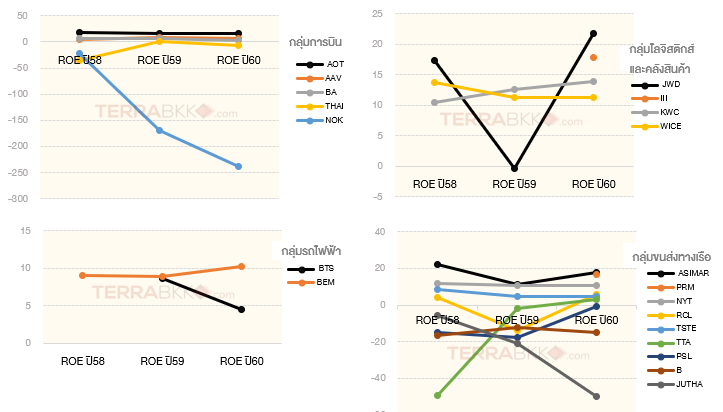
To reflect the ability to manage and generate returns for shareholders as business owners, investors in the stock market often look at the return on equity (ROE), where a higher value is better. Overall, the performance is generally in the single and double-digit percentages. Therefore, the four companies that achieved the highest ratios in each group are JWD InfoLogistics (JWD) at 21.82% in the logistics sector, and the highest in the transportation sector of Thailand is Asian Marine Services (ASIMAR) at 17.79% in the shipping group, Airports of Thailand (AOT) at 16.37% in the airline sector, and Bangkok Expressway and Metro (BEM) at 10.28% in the railway sector. Additionally, only two companies have shown continuous growth in ROE (Up Trend) over the past three years: Bangkok Sopha (KWC), a warehouse and document storage business, and Thoresen Thai Agencies (TTA), a shipping and other transport business.
 Who has the highest ROA in Airlines, Shipping, Railways, and Logistics?
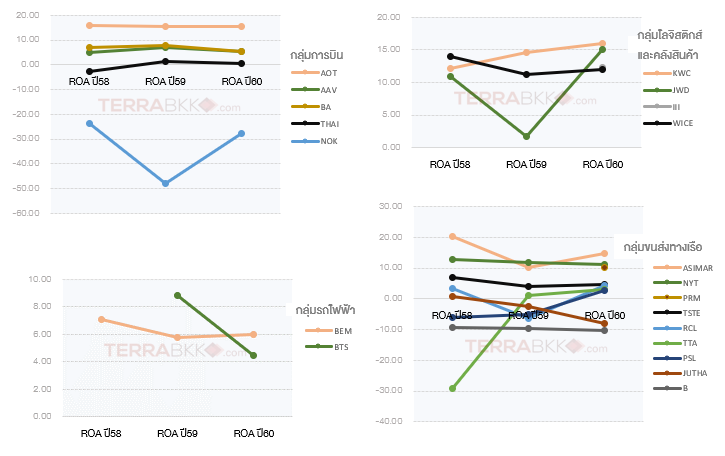
Investing in assets for business operations is common. The comparison of performance in this regard can be observed through the return on assets (ROA) to reflect the company's efficiency in utilizing assets to generate returns. The higher the result, the better. Overall, this group typically has values in the single digits, while the logistics sector averages in the double digits, being the best in the transportation sector. Bangkok Sopha (KWC) is the winner with the highest ROA at 16.05% in the logistics sector, and the highest in the transportation sector of Thailand. Meanwhile, in the shipping sector, Asian Marine Services (ASIMAR) has 14.88%, the highest in the group. In the airline sector, Airports of Thailand (AOT) has 15.62%. For the railway sector, the figures are quite close, with Bangkok Expressway and Metro (BEM) at 6% and BTS Group Holdings (BTS) at 4.46%. If we look at the trend of continuous ROE growth (Up Trend) over the past three years, only two companies are found: Bangkok Sopha (KWC), a warehouse and document storage business, and Thoresen Thai Agencies (TTA), a shipping and other transport business.
Who has the highest net profit margin in Airlines, Shipping, Railways, and Logistics?
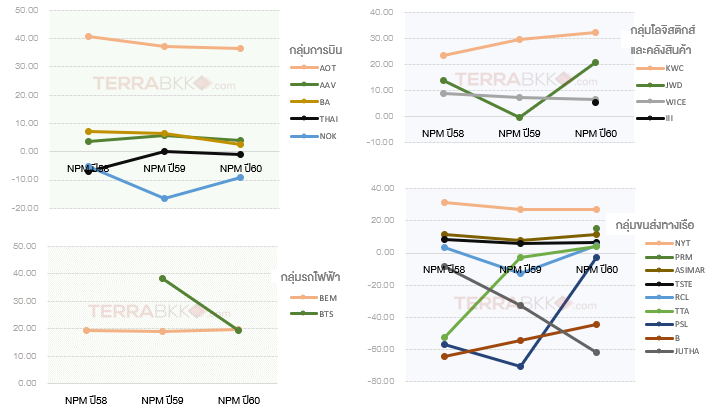
Looking back at the performance over the past three years, it is evident that businesses such as ports or airports consistently generate high net profit margins within the transportation sector. For example, Airports of Thailand (AOT) at 36.45% in the airline sector, Nam Yong Terminal (NYT) at 27.33% in the shipping sector, and Bangkok Sopha (KWC) at 32.27% in the warehouse sector. Meanwhile, in the railway sector, Bangkok Expressway and Metro (BEM) achieved 19.77% and BTS Group Holdings (BTS) at 19.25%, which is also commendable.
Finally, regarding the management of the debt-to-equity ratio, the overall transportation sector is considered to be in good condition, with most companies having a ratio not exceeding 2 times. However, there are two companies that raise concerns: Thai Airways (THAI) at 7.8 times and Nok Air (NOK) at 5.05 times, along with Bangkok Expressway and Metro (BEM), which shows a trend of increasing D/E ratio: 1.69 times (2015), 1.79 times (2016), and 2.18 times (2017). ---TerraBKK
Article by: TerraBKK Investment Tips
TerraBKK: Find good, valuable, and affordable homes