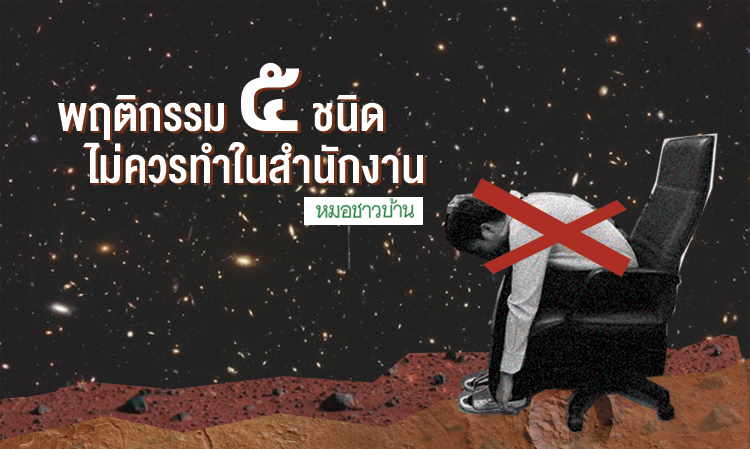
5 Behaviors to Avoid in the Office
Office workers often experience pain in the upper back (shoulder blades) and lower back (waist) due to their work. The main causes are:
1) Incorrect posture
2) Staying in one position for too long (even if the posture is correct)
3) Inappropriate exercise positions
Some exercise positions are performed repeatedly without understanding their purpose. Upon detailed analysis, some positions can be more harmful than beneficial. In this article, the author has compiled activities that increase the risk of back pain for those who sit at desks.
5 Things to Avoid
1. Sitting for more than 2 hours While sitting, the weight of the head and torso compresses the intervertebral discs, which resemble jelly. The fluid inside can seep out through capillaries. The longer one sits, the more pressure from the upper body reduces the water content in the discs, similar to how a cushion compresses the longer one sits on it. If the water content in the disc decreases, it loses flexibility, increasing the risk of injury from movements that exert pressure or twist the disc while sitting or during other activities afterward, such as lifting heavy objects after prolonged sitting.
On average, the phenomenon of disc compression occurs after about 2 hours, but some individuals may experience it sooner. The best method is to stand up and change positions every hour. I would like to share the advice of Dr. Kirint Mekhora from the Faculty of Physical Therapy at Mahidol University, who advises office workers to drink plenty of water. This means that after drinking a lot, one will need to get up to go to the restroom.
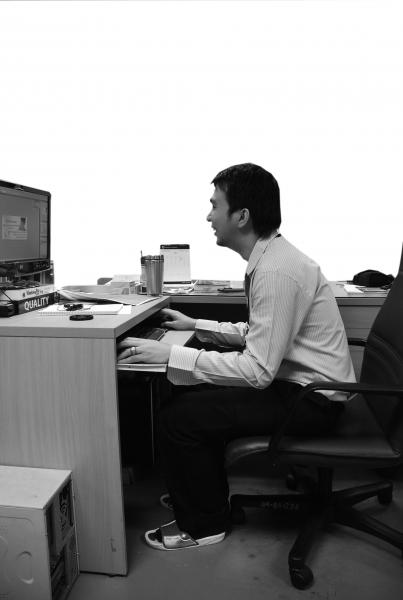
2. Slouching (Figure 1) When the upper back slouches, it causes the lower back to curve or bulge out more (reversed lordotic curve). This posture increases pressure on the spinal discs and makes it easier for them to slip backward due to the prolonged stretching of the back tissues. What should be done is to avoid slouching for long periods while sitting or staying in any one position for too long. Frequent position changes are recommended.
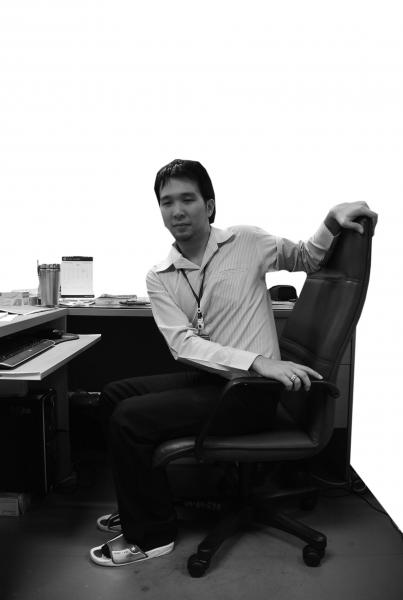
3. Twisting while sitting (Figure 2) When sitting for long periods, the discs lose flexibility as mentioned earlier. Twisting or rotating can easily damage the discs. Compare it to jelly; if we apply pressure while twisting, it tears more easily than just applying pressure alone. Those who enjoy twisting exercises while sitting should stop. If you want to twist, stand up, arch your back to restore the discs for a few moments, and then twist.
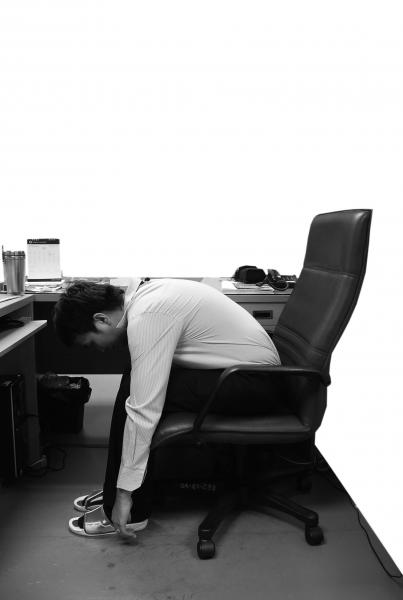
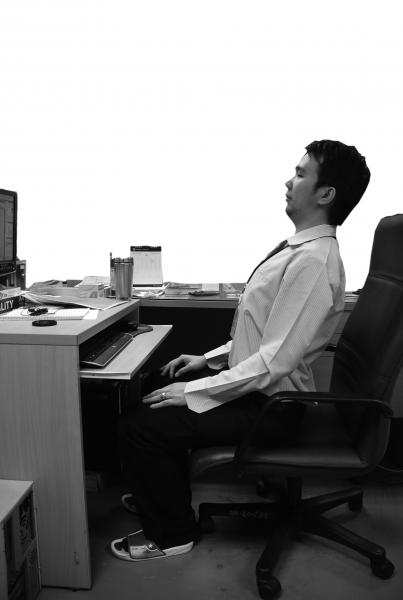
4. Leaning forward excessively while sitting (Figure 3) Some may use this position for exercise. Sitting already exerts high pressure on the spinal discs, and leaning forward further stretches the back tissues, risking strain or tearing. This position is more suitable for those with stiff backs who cannot bend much. Most office workers are already sitting, which means they are leaning forward. Leaning down further does not help; it only stretches the back that is already being stretched from sitting.
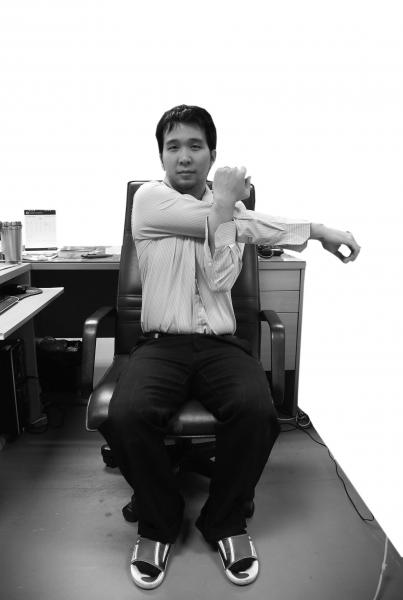
5. Stretching the shoulder blade muscles (Figure 4) While working, our hands are always in front. The muscles between the shoulder blades (Rhomboid major and minor) are already stretched. Stretching these muscles further can increase their length beyond normal (looseness), reducing the muscle strength needed to work at normal length, making them more prone to injury. As a physical therapist, I have encountered patients with unusually long shoulder blade muscles who experience pain in the muscles between the shoulder blades. Further stretching these muscles through exercise in Figure 4 can cause them to loosen even more. Sometimes patients receive treatment through pressure in that area, which can lead to more injury as the muscles become looser. When the muscles exert force, they may get injured.
5 Things to Do
1. Stand and arch your back (Figure 5) After sitting for a while, you should stand up and arch your back by placing your hands on your waist and arching for 10-20 seconds. Arching helps the discs recover from compression and stretches the abdominal muscles, hip flexors, and chest muscles that tend to shorten from prolonged sitting.
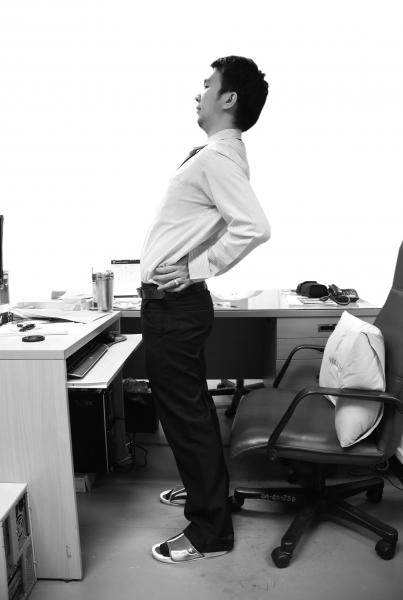
2. Stand and twist (Figure 6) Twisting helps stretch the side muscles of the torso and increases the flexibility of the back tissues. Standing and twisting is better than sitting and twisting because the pressure on the spinal discs is much lower. Slowly twist your torso until you feel a stretch on the side and hold for about 10 seconds before twisting to the other side. Do not twist quickly as it may cause muscle or tissue tears in the back.
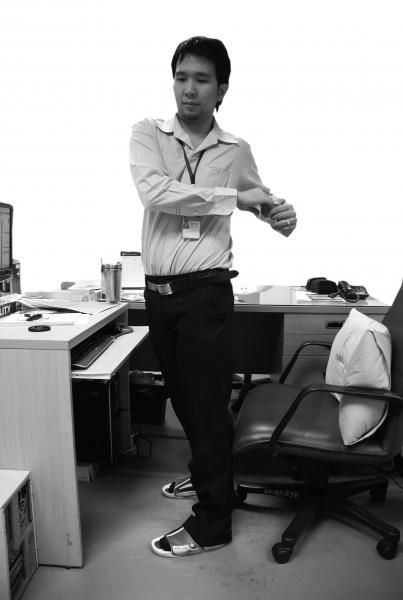
3. Sit and arch your back (Figure 7) If you cannot stand and arch your back, such as during long meetings, you can sit and arch your back for about 10 seconds or use a cushion to support your back. This will help reduce pressure on the spinal discs, but it is less effective than standing and arching. If you do not want to arch your back, change positions frequently, such as sitting with your feet on the table, leaning back, or sitting sideways, but not exceeding 5 minutes in each position. Doing this prevents the back tissues from being stretched for too long in certain sitting positions, allowing for alternating stretching and contracting of the tissues.
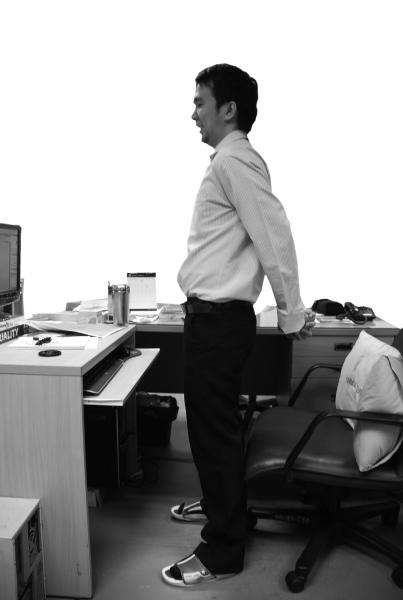
4. Stretch the chest muscles The chest muscles often shorten from using the hands and arms to work forward all the time. Shortened chest muscles can contribute to slouching, upper back pain, and may lead to shoulder pain. Stretching the chest muscles can be done while standing by clasping your hands behind your back and raising your arms straight up without bending your body (Figure 8). Hold for 10 seconds. If you cannot stand, you can sit but slide to the edge of the chair to have space to raise your arms.
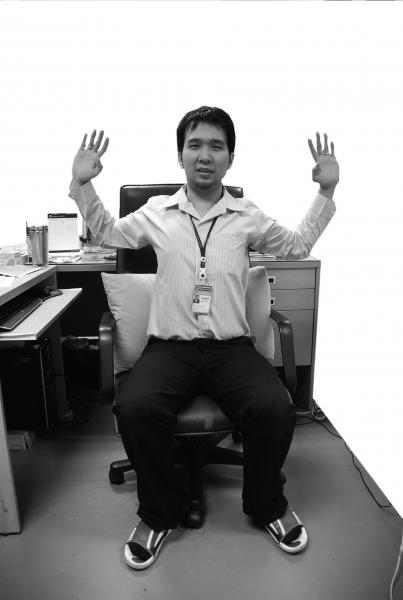
5. Strengthen the shoulder blade muscles As mentioned, muscles often become loose from being stretched regularly. Strengthening exercises (not stretching) for the shoulder blade muscles can help them regain their normal length. Sit or stand with your arms extended at 90 degrees and raise your hands up, similar to a surrender pose. Try to pull your elbows back as much as possible (Figure 9). You will feel the muscles between your shoulder blades working. Hold for 5 seconds and repeat 2-3 times.
Office workers should engage in brisk walking or running every other day, which has dual benefits: 1) improving cardiovascular fitness and 2) when the arms and legs move, the back also moves, enhancing blood flow to the back area, making it more flexible and less prone to injury.
Thank you for the information from www.doctor.or.th