
Anti-inflammatory Drugs: Not Just for Inflammation (Universal Use) but Also Antibiotics
I have some questions regarding anti-inflammatory drugs. I would like to ask the doctor the following:
1. Why do I receive different anti-inflammatory medications each time I visit the doctor? I notice that they have different names, such as ampicillin or amoxicillin.
2. Can different anti-inflammatory medications be used interchangeably? Or is it that for this particular illness, I must take this specific anti-inflammatory drug, while for another illness, I need a different one?
3. If I have an anti-inflammatory medication at home, such as ampicillin, and I develop a sore throat due to tonsillitis, can I take the ampicillin, or do I need to buy a different medication?
4. I once saw someone in my neighborhood with a pus-filled wound on their toe (from an ingrown nail), and they took an anti-inflammatory medication, opened the capsule, and sprinkled the powder directly onto the wound. I wonder if this method is effective or if it could be harmful?
5. Which anti-inflammatory drug is the best or has the most comprehensive treatment capabilities? Also, which drug is more likely to cause allergic reactions so that I can avoid it?
Please kindly explain and provide recommendations.
Napas / Bangkok
Regarding the anti-inflammatory drugs you mentioned, I would like to clarify the terminology used to enhance understanding of their properties, benefits, and precautions. The term "anti-inflammatory drug" as you refer to it here is understood to mean the group of antibiotics, which have the ability to destroy bacteria. They are beneficial in treating various bacterial infections such as tonsillitis, ear infections, bronchitis, pneumonia, dysentery, typhoid, cholera, urinary tract infections, abscesses, boils, and pus-filled wounds. Since the term "antibiotic" is medical jargon that may be somewhat difficult to understand, when these drugs were first introduced (40-50 years ago), doctors adapted the name to a more layman-friendly term, "anti-inflammatory drug." When this medication is taken, it destroys or kills the bacteria that cause the infectious disease, thus alleviating the symptoms of inflammation (such as pain, swelling, redness, and heat in the infected area, like abscesses or inflamed tonsils, which are visibly apparent).
This name has become familiar to the public over time, leading to the belief that these drugs have properties to reduce inflammation. Therefore, when experiencing minor symptoms such as coughing, sore throat, cold, diarrhea, or fever, people often think that inflammation is occurring and seek to buy or request a prescription for "anti-inflammatory drugs" (which are antibiotics) for treatment. In reality, inflammation can have many causes and does not always stem from bacterial infections. For instance, coughing or a sore throat may arise from irritation due to dust, cigarette smoke, allergies, or viral infections. Symptoms like fever or diarrhea can also be caused by viruses. If the cause is one of these, using antibiotics (under the misconception that they help with inflammation) would be ineffective, considered unnecessary medication, and could lead to side effects, allergic reactions, and contribute to antibiotic resistance.
Antibiotics are only effective against bacterial infections. Personally, I believe to prevent confusion that leads to misuse, we should refer to this group of drugs using the medical term "antibiotics" or, in layman's terms, we could call them "bactericidal drugs" to convey the meaning accurately. I encourage everyone to understand this issue and share it with those around them.
As for your questions, I will answer them point by point:
1. The reason for receiving different antibiotics is that each illness (specifically, bacterial infection) may arise from different causes (bacteria). Even if it is the same type of bacterial infection, different doctors may choose different antibiotics, or the same doctor may select different antibiotics on different occasions. This is because a specific type of bacteria often has more than one antibiotic option available. For example, for a pus-filled tonsillitis, options may include penicillin, amoxicillin, or erythromycin, depending on the doctor's preference or the availability of the medication at that time. Additionally, the same medication may have different brands and forms, leading to the misunderstanding that they are different types of drugs. It is important to learn the generic names of these medications and remember them.
2. and 3. The answer is the same: it depends on the specific antibiotic's effectiveness against the type of bacteria. One type of antibiotic can treat more than one bacterial infection, and one bacterial infection may have multiple antibiotics available for treatment (see examples in the table).
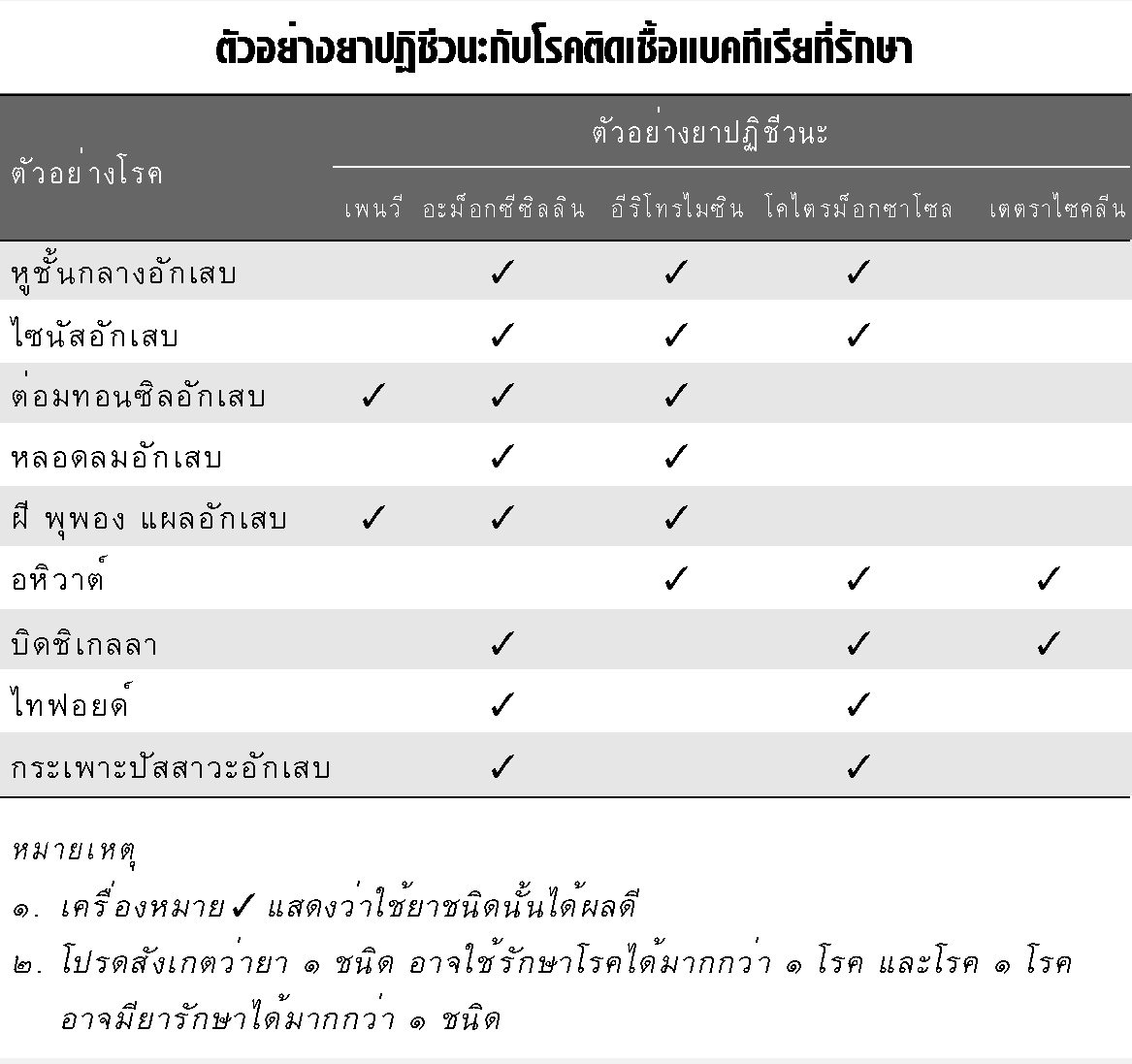
4. I do not recommend doing that, as it may not be effective and could cause allergic reactions on the skin where the powder is applied. It is common to see people using penicillin or sulfa drugs on wounds; initially, it may appear to dry well, but later, they may experience redness, itching, and pus formation. Alternatively, the powder may clump together, covering the wound, leading to the appearance of a dry wound while pus accumulates underneath. For skin wounds, I recommend cleaning the wound with boiled water or saline to remove pus and applying honey (on the wound), covering it with gauze, and doing this twice a day for a few days until it improves. For wounds caused by ingrown nails, it may be necessary to have a doctor trim the ingrown nail for effective treatment.
5. There is no antibiotic in the world that is the best or universally effective. Each drug has a different scope of treatment. The use of antibiotics must be appropriate for the specific disease (matching the bacteria), the correct dosage, and the correct duration (full course). If used for the wrong disease, it will be ineffective; if the dosage is incorrect, it may be ineffective (too low) or dangerous (too high). If the duration is not completed, the disease may relapse, and the bacteria may develop resistance.
All antibiotics can cause allergic reactions, leading to symptoms like hives, rashes, asthma, or even severe reactions like anaphylactic shock. Antibiotics that are more likely to cause allergies include penicillin (such as Pen-V, ampicillin, amoxicillin) and sulfa drugs (such as co-trimoxazole). Those with a history of drug allergies should avoid these medications, and those with a history of allergies should use them with caution. However, I recommend consulting a doctor or pharmacist before using antibiotics, as there are many guidelines and precautions for their use compared to fever reducers (like paracetamol) and antihistamines (like chlorpheniramine). Importantly, do not use them indiscriminately; just because you have a slight cold, a little cough, or a mild fever, do not take antibiotics thinking they are "anti-inflammatory drugs" as mentioned earlier.
Antibiotics are not universal anti-inflammatory drugs but are "bactericidal drugs". If misused or overused, in the future, bacteria may kill us, as some bacteria may become resistant to all antibiotics, making it impossible to find any antibiotic to treat them. Currently, the medical community worldwide is concerned that if there is ever an outbreak of drug-resistant bacteria, humanity will face a catastrophic threat. Before using "anti-inflammatory drugs" (antibiotics), please think carefully.
Thank you for the information from www.doctor.or.th