When Space is 'Limited': The Future of Housing May Be as Small as a Mouse Hole
The world's population is increasingly moving to cities
The straightforward market mechanism of 'demand' and 'supply' is a key indicator of rising housing prices. As demand clusters, supply inevitably increases in value. This aligns with the World Bank's forecast that the global population will rise from 7.4 billion to over 8 billion in the next 20 years, with over 60% of that population expected to live in urban areas. Although it is predicted that housing prices will stabilize in the future due to the inability to sell high-priced goods, as most of the population will remain in the middle-income bracket, it is possible that developers will downsize housing to adjust to rising land prices instead.
The trend of modern singles
Another global trend that reduces the need for larger housing is the increasing tendency for people to remain single. According to a forecast by the World Bank, by 2030, the birth rate will decline by 1.3% per year to just 0.9%. Additionally, the website Deloitte has reported a continuous growth in the single population in America over the next 13 years, impacting the demand for home purchases, shifting it towards renting instead.
In Thailand, the number of singles in 2016 was approximately 14.51 million, while those married numbered about 34.41 million. By 2017, the number of singles had increased by around 400,000, while the number of marriages decreased by 600,000, along with an increase in divorces by over 2,000. This indicates that the Thai population is becoming more single, marrying less, and experiencing higher divorce rates.
Decreasing housing sizes in Hong Kong and Tokyo
'Hong Kong', known for its exorbitant real estate prices, has housing prices for a 14 sq.m. room, which is even below the minimum size required by Thai law, priced at around 12 million baht. Currently, housing prices in Hong Kong are 18 times the average salary of the entire country. This is partly due to the land transaction tax imposed by the Hong Kong government, which forces the state to keep property prices high to maintain tax revenue, resulting in high development costs. Consequently, housing in Hong Kong has become unaffordable, with residents needing to spend half their salary on tiny living spaces for up to 36 years and for low-income individuals, the average living space is only 4.6 sq.m.
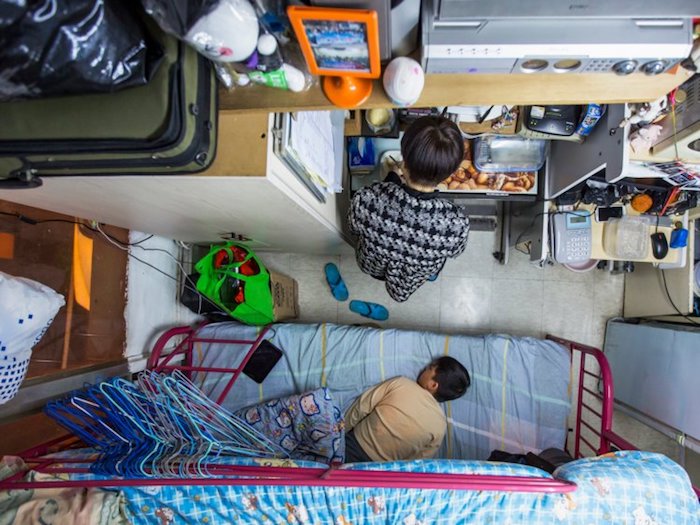
Image source: http://www.businessinsider.com/
On the other hand, the Japanese television channel ANN News reported on a rental room in a brand new apartment just 1.5 years old in the bustling Shibuya business district, only a 5-minute walk from the Hatagaya train station, with a monthly rent of 18,000 baht. This sounds appealing until one realizes that the apartment is only 4.86 sq.m.! Furthermore, in Tokyo, there are rooms of 8 sq.m. available for 20,000 baht per month, which is considered extremely expensive for the quality of life in a major city like Tokyo.
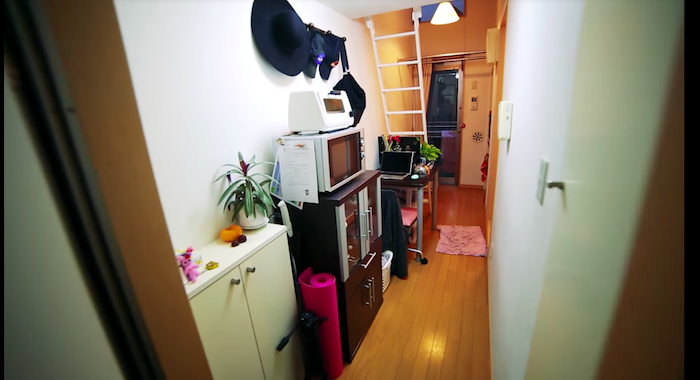
Image source: https://youtu.be/TYVJbupG3Xg
Smaller condominium sizes in Thailand
Although Thailand has laws regulating the minimum living space in residential buildings to not less than 20 sq.m., preventing the emergence of mouse-hole-sized rooms like those in the aforementioned countries, condominiums in Bangkok have been shrinking in size over the past 8-9 years.
According to a survey of available condominiums in the Ratchayothin and Phaholyothin-Jatujak areas by TerraBKK Research, it was found that the supply in Ratchayothin is mostly concentrated in the 26-35 sq.m. range, accounting for about 45% of the total supply (as of October 2017). Similarly, in the Phaholyothin-Jatujak area, rooms sized 26-35 sq.m. make up 65% of the supply, with 26-30 sq.m. rooms at 34% and 31-35 sq.m. rooms at 31% (as of May 2017). Notably, there has been an increase in studio-type rooms, mostly sized at 21-22 sq.m., which is just 1-2 sq.m. above the legal minimum.
The trend of downsizing units by developers is largely influenced by location and the rising cost of land. For instance, Ananda Development has begun reducing the size of studio rooms from 26.5 sq.m. in 2010 to 21-21.5 sq.m., and one-bedroom units from 35 sq.m. in 2010 to 24.5-30 sq.m. in the following 3-5 years.
In comparison to condominiums built before the bubble burst, the difference is stark. Older condominiums, constructed 20-30 years ago, typically have the smallest units no less than 40 sq.m., with most being over 50 sq.m. It can be said that as more units are developed, people still have the purchasing power to afford them.
It is clear that new housing developments, both condominiums and apartments, are becoming significantly smaller, especially in urban areas near train stations. The smallest legally compliant apartments are 20 sq.m. with security systems and keycard access in the Ratchada area, starting at a rent of 5,500 baht per month. Urban residents are willing to pay for the convenience of transportation and safety in their living environments.
Housing types like Micro apartments are continuously growing in densely populated cities like Hong Kong, Japan, and South Korea, particularly in newly opened apartments over the past 1-3 years. This represents a new trend in cities facing housing shortages (affordable housing). Besides Tokyo and Hong Kong, this trend is also emerging in major cities worldwide, such as New York, Paris, and London.
Article by: TerraBKK Investment Tips
TerraBKK: Find good, valuable, and affordable homes