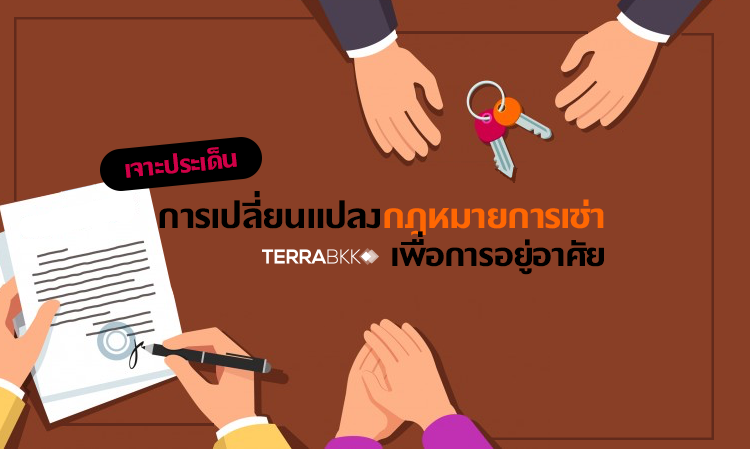
Exploring Changes in Residential Lease Laws
The amendment of the building lease law for residential purposes and its implementation methods
Residential Lease Agreement is a contract regulated by the new law, effective from May 1, 2018.
The announcement by the Contract Committee under the Consumer Protection Act of 1979 states that any lease agreements signed before this announcement must be redone.
Key changes include:
1. Security Deposit
The security deposit can only be collected for 1 month, plus an additional month of rent in advance, totaling 2 months. If the landlord violates this, the contract clause in question is considered void, and the new legal provisions will apply instead. If the landlord neglects to comply and fails to provide a new contract that adheres to the law, they may face criminal charges, including up to 1 year in prison and a fine of up to 100,000 baht.
2. Return of Security Deposit and Advance Rent
The landlord must return the excess security deposit and advance rent immediately upon the enforcement of the new law, or at the latest within 30 days. The new law does not specify the timeframe for providing the new contract to the tenant, but it should follow the standard business practices for residential leases. For new tenants, a new contract must be created before they move in. For existing contracts that are illegal, they must be corrected immediately upon the new law's enforcement, or within 30 days, similar to the return of excess security deposits and advance rent.
Regarding security deposits and advance rent, there is a question of whether the landlord can forfeit these amounts if the tenant fails to pay rent or damages the property. The purpose of the security deposit and advance rent is to protect the landlord in these situations. The new law prohibits the forfeiture of security deposits and advance rent during the lease term, meaning landlords cannot claim these amounts for tenant breaches. However, if the lease ends for any reason and the tenant owes rent or damages the property, the landlord may offset these debts against the security deposit and advance rent.
Upon the lease's termination, if there is no property damage, the landlord must return the security deposit to the tenant within 7 days. Terms like 30 or 60 days are no longer acceptable. If the property is in a high-demand area, stating that a 1-month deposit is required to reserve a room, and if the tenant does not sign the lease within 30 days, the landlord can rent the room to someone else and forfeit the deposit, is now prohibited.
3. Taxes
Stamp duty on the lease agreement is 0.1% of the total rent, property tax is 12.5% on the building and land leased, and signage tax must not be passed on to the tenant. The announcement by the Contract Committee does not explicitly prohibit this, but it is considered unfair to the tenant. If landlords suspect any contract terms are unfair or violate the new law, they may request a ruling from the Contract Committee.
4. Landlord's Right to Increase Rent and Fees
During the lease term, landlords cannot increase rent or fees arbitrarily or create short-term leases with low initial rent followed by a significant increase upon renewal, as this is deemed unfair to consumers.
Regarding service fees, some have suggested that since the new law regulates lease agreements but not service contracts, service agreements should be separate. However, this approach is seen as an attempt to circumvent the law and is not enforceable.
Another common issue is the landlord's self-imposed charges for utilities, such as electricity, water, and telephone services, which must be based on actual costs with supporting evidence, not inflated for profit, as is common in hotels.
Charging exorbitant parking fees in a city center where parking is always full, forcing tenants to search for parking elsewhere, is also considered excessive and may lead to complaints or legal action.
Maintenance and repairs of the rental property, which landlords often resist paying for, whether for major repairs or normal wear and tear, must be addressed. For example, if window screens are old and damaged, landlords cannot expect tenants to cover these costs, as this would be seen as taking advantage of the tenant.
5. Inspection of Rental Property
Landlords cannot reserve the right to inspect the rental property at any time without prior notice to the tenant, as this is strictly prohibited.
The provisions in the new law affect the income stability of real estate investment trusts, leading to increased tenant turnover, as tenants can terminate leases early with 30 days' notice.
6. Termination of Lease
Terminating a lease is not straightforward. A landlord cannot simply terminate the lease because the tenant breached a minor term. The landlord must wait for a significant breach, which must be clearly stated in the lease agreement in bold or highlighted text. Before terminating the lease, the landlord must provide written notice to the tenant to comply with the lease within 30 days. If the tenant fails to comply, then the landlord may terminate the lease.
7. Enforcement Measures by the Landlord
Landlords are prohibited from taking drastic measures against tenants who fail to pay rent, such as locking them out or seizing their property. Landlords must carefully review their lease agreements to identify any clauses that violate the law or may be interpreted as unfair to tenants and amend them before the new law takes effect to mitigate risks of unenforceable clauses or potential civil and criminal liabilities.
It is crucial to plan ahead for preparing new lease agreements and returning any excess security deposits.
Discussion
Follow breaking news Investment property articles on Facebook, click here.