The State of Thai Real Estate in 2018
Global Economy, Thai Economy, and the Real Estate Market in 2018 <\/span><\/strong><\/p>
The global economy continues to improve steadily <\/strong><\/span> due to the fundamental factors in the real business sector. Inflation is expected to rise but remains at a low level, which is not alarming. Consequently, interest rates are likely to increase in the short term, as evidenced by foreign countries easing their monetary stimulus policies like QE. The capital market or stock market continues to rise steadily. It is anticipated that the global economy will grow by 3.9% in 2018.<\/strong><\/span> The Thai economy <\/span><\/strong> initially showed a clustered recovery, starting from the tourism sector, which improved in 2015, along with government investment stimulus. Subsequently, the export sector began to recover in mid-2016, and by mid-2017, improvements were seen in the industrial sector and private investment. Therefore, the Thai economy in 2018 is expected to grow more broadly.<\/span> <\/strong><\/span> Employment figures are projected to improve. The National Economic and Social Development Board estimates the GDP for 2018 at 4.1%<\/span> <\/em><\/strong>, while the Bank of Thailand forecasts it at 3.9%<\/strong>, and TMB Bank predicts 4.2%<\/strong>. Key factors to watch this year include the recovery of domestic demand and the momentum from government spending, particularly in infrastructure investment projects. For the Thai real estate market in 2018, it is seen as having a recovery trend, but not uniformly.<\/span><\/strong> The upper and middle markets are growing well, especially in locations near the subway and surrounding areas, while the lower-end real estate market has not yet recovered, and conditions in provincial areas are not very favorable. The main pressure remains the high household debt level, and consumer purchasing power has not expanded robustly. Additionally, financial institutions remain cautious in granting new loans. Regulations, Legal Issues, and Impacts on Thai Real Estate Development in 2018 <\/span><\/strong><\/p>
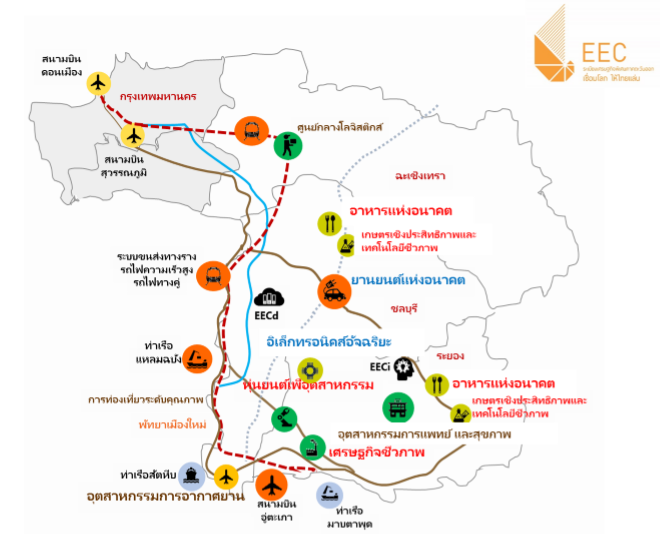
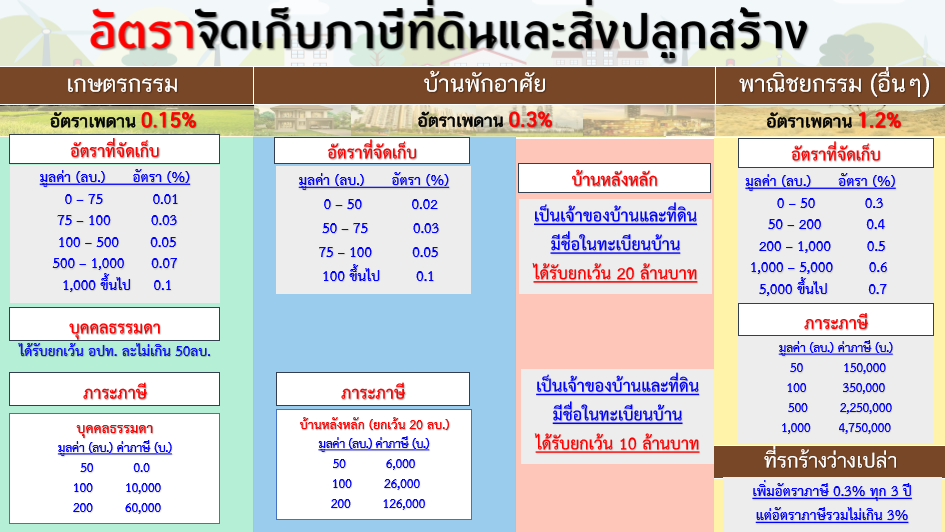
The EEC project, a development initiative aligned with Thailand 4.0, is a key driver for creating a new S Curve for the country.<\/strong><\/span> This involves the development of the Eastern Economic Corridor, including real estate projects such as infrastructure development, industrial promotion zones, education and technology research, tourism promotion, and new city development. Progress on five major infrastructure projects is as follows: Additionally, the draft of the Eastern Special Development Zone Act is expected to be announced in the first quarter of 2018. Regarding the draft of the Land and Building Tax Act, the local maintenance tax and building tax have been abolished and replaced with "Land and Building Tax"<\/strong>. This change is expected to help the Thai real estate sector increase the supply of land for agriculture. For the industrial sector, the calculation of tax based on machinery rental has been abolished. In real estate, this will help reduce land hoarding or speculation, as well as decrease the amount of vacant land, adjusting land use to be more suitable for the area, with rates collected based on type. Market Trends in Thai Real Estate and Business Strategies for 2018 <\/span><\/strong><\/p>
The growth rate of Thai real estate in 2018 is projected to be around 5-10%.<\/span> “Condominiums” remain the sector with the highest volume of sales and transfers, especially in Bangkok (along the subway lines), but “townhouses”<\/strong> will see higher growth. Overall, real estate prices are expected to rise by an average of 3-10% per year<\/span> due to increasing land costs. The estimated supply of residential units in Bangkok and surrounding areas for 2018 is expected to exceed 154,200 units, with the highest in Bangkok at 69,300 units, followed by Nonthaburi at 30,300 units and Samut Prakan at 21,600 units, with the remainder distributed in Pathum Thani, Samut Sakhon, and Nakhon Pathom. Business strategies for Thai real estate in 2018 recommend focusing on <\/span>products<\/strong> that offer value for money and are smart homes in the price range of 1.5-5 million baht (accounting for 65% of the market). Suitable locations<\/strong> such as condominiums along subway lines, single houses at the end of subway lines, or near expressways. For townhouses, they should be located between the aforementioned condominiums and single houses. For residential project investments in provincial areas, focus should be on provinces with comprehensive potential in both commercial and tourism sectors. Additionally, consider projects that align with demand<\/strong> and be cautious about launching new residential sales in areas with high existing supply, while also considering consumers' debt repayment capabilities. Finally, manage liquidity<\/strong> to survive in a market that may change unexpectedly, such as labor costs, material prices, and interest rates.--- TerraBKK summarizes key information from the real estate seminar, key economic indicators for 2018 <\/strong> Article by: TerraBKK Investment Tips<\/span><\/strong> <\/strong><\/p>
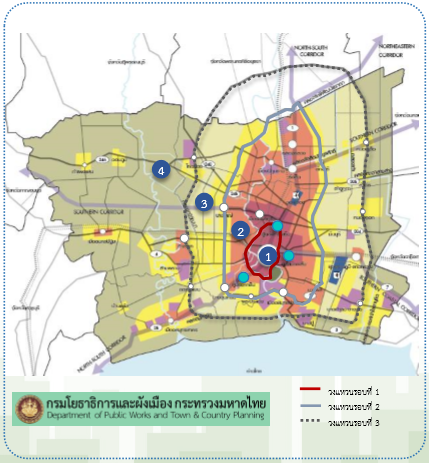
Regarding the overall progress of urban planning, an interesting aspect of Thai real estate is the concept of urban planning for Bangkok and surrounding areas, with a vision for 2580<\/span> <\/strong> to become a "competitive metropolis that is livable and sustainably developed." <\/strong> This is divided into four zones:
TerraBKK: Find good, valuable, and affordable homes<\/span><\/strong><\/p>