The Diversity of Home Buying Among Gen Y
Having just passed the New Year festival, the familiar sight of heavy traffic on the roads returning home has returned once again. This aligns with the global trend that TerraBKK previously presented regarding the increasing urban population Read the article here. However, beyond the influx into major cities, there is also the aspect of relocation and the opportunities for establishing a stable life for the large global population of Gen Y.
Since purchasing a home is a long-term commitment for salaried individuals, careful consideration is necessary before making a purchase. An interesting study from the Brookings Institute examined residential satisfaction between urban and suburban locations. They surveyed a sample population of 1,506 individuals from Gen Y, the largest demographic group in the world, and found that 66% wanted to move to suburban areas, 24% preferred rural living, and only 10% wished to reside in the city center. The main reason cited was the desire for housing with more space, which is more expensive in urban locations.
Additionally, there is a consistent opinion from David Berson, Chief Economist at Nationwide Insurance Co., who stated that Gen Y prefers to live in suburban areas over urban ones but still desires the conveniences found in city centers. This indicates a strong trend towards Gen Y being satisfied living in locations that are a midpoint between suburban and urban areas.
Another interesting aspect regarding Gen Y is their Live-Work-Play lifestyle, which influences their home-buying decisions.
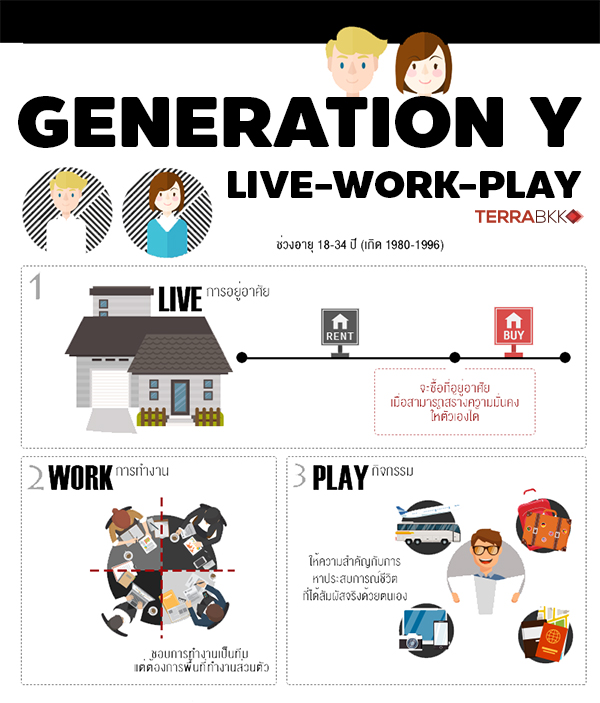
Living Behavior (Live) - Currently, 49% of Gen Y individuals live with family or parents, planning to live independently within 2-3 years, but at some point, many return to live with their families. This living arrangement is referred to as the “Boomerang Generation” due to their inability to manage the rising costs of homeownership. In populous countries like China or India, it is common for Gen Y to live with their families until they establish their own households, and even after marriage, many continue to live with their parents.
However, 51% of Gen Y still choose to live independently for the sake of freedom, often opting to rent rather than buy, leading to the term “Renting Era”. Their desire for independence and love for challenges makes them feel that purchasing property for personal residence is not worth the financial investment.
According to a survey of 13,000 Gen Y individuals across 20 countries, 55% do not expect to purchase their own homes due to rising prices. In the United States, surveys support the trend of changing homeownership expectations, revealing that 57% of current individuals believe owning a home is no longer important for Gen Y, and 54% think renting is more appealing for this generation.
Another interesting statistic is that, on average, Gen Y spends 1 in 3 of their total income on housing. Whether buying or renting, Gen Y is only willing to spend this amount. They also refuse to pay large sums or save for a down payment on their own homes. About 33% of Gen Y individuals considering homeownership plan to borrow from family or take out bank loans for a down payment. This behavior is prevalent in Asia and is increasing in the United States. Additionally, many Gen Y individuals carry student debt from undergraduate and graduate studies, with only 16% wanting to own a home but not planning for homeownership at the beginning of their careers, indicating that renting will likely be a long-term arrangement compared to previous generations.
Work Behavior (Work) - The work behavior hypothesis for Gen Y suggests that their tenure at any organization is often short. This group does not commit to any one place for long periods. Among 13,000 Gen Y individuals surveyed across 20 countries, 62% expressed satisfaction in moving to higher positions or challenging roles, often choosing organizations that offer freedom and promote innovative thinking. Those who stay with a company for extended periods do so because the company provides opportunities for lifelong learning and personal development. Many Gen Y individuals are willing to change jobs frequently to acquire new skills, and 56% believe that work and life should be separated.
Leisure Behavior (Play) - Since some Gen Y individuals live with family or rent, their spending burden is lighter than previous generations. The remaining funds Gen Y allocates towards leisure spending up to 48% of their total income, such as travel, online shopping, movie watching, concert attendance, or dining out. Surveys indicate that Gen Y frequents shopping malls more significantly than previous generations, who typically went just to shop and leave. Despite statistical data confirming that online shopping has increased among Gen Y compared to Baby Boomers,
Based on all the information above, it cannot be definitively concluded that Gen Y will not prefer to buy homes. It may be due to financial reasons or changing lifestyle patterns. The solution to this issue may need to be a challenge for developers to consider how they can assist, create promotions, or accommodate the financial burdens of Gen Y to enable them to purchase housing. Additionally, adapting housing design to ‘understand’ the needs of Gen Y will be essential for timely adaptation.
TerraBKK recognizes the importance of this issue and has organized its first major seminar on 'Generation Y's Behavior & Lifestyle Study' to seek clear answers and solutions tailored to this largest demographic group in the world. The study involved over 500 participants from across Bangkok and delved into how developers are increasingly prioritizing this issue. The event is scheduled for February 8, 2018, at the S31 Hotel in Sukhumvit.

For inquiries, tickets can be purchased at 092-697-4320 or Email: [email protected]
Interested in buying tickets? Click here
Article by: TerraBKK Real Estate News
TerraBKK: Find good, valuable, and affordable homes