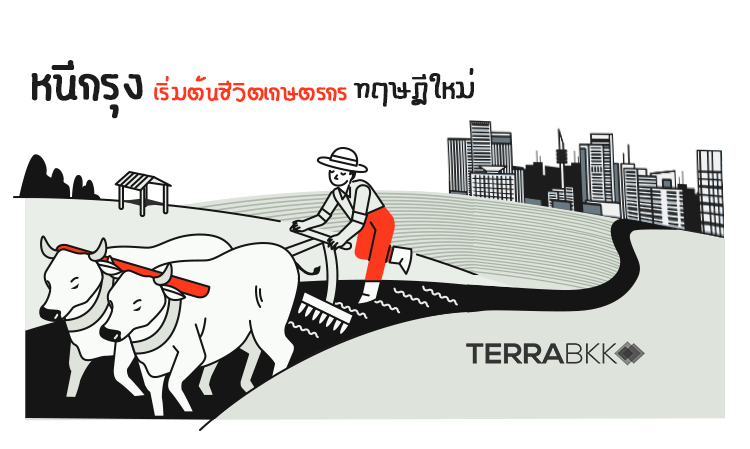
Escaping the City: Starting a Life as a Farmer with the New Theory
In 1989, King Rama IX conducted practical studies and research on the New Theory on his royal land of 16 rai, 2 ngan, and 23 square wah in Huai Bong Subdistrict, Mueang District, Saraburi Province. He later entrusted the Chaipattana Foundation, which he established, to continue supporting the government's projects, serving as a demonstration model for development and assistance to farmers facing difficulties due to water shortages. This royal initiative is referred to as the "New Theory", which is a management approach for land and water for agriculture on small plots to maximize benefits. The New Theory for agriculture is not designed for greed or the pursuit of wealth, but rather for sustainable living based on the principles of sufficiency economy. Key guidelines include:
- Farmers can sustain themselves at a frugal level and rely on community cooperation, such as traditional "volunteer work" to reduce costs.
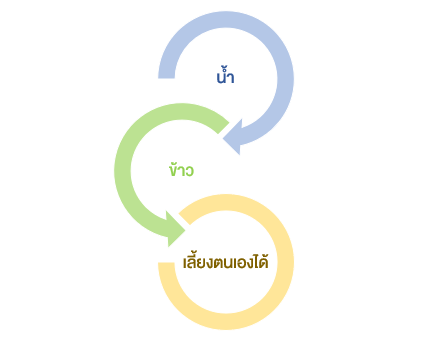
- Farmers will have rice to eat throughout the year from 5 rai of rice fields, adhering to the principle of self-sufficiency with independence.
- Farmers will have water for cultivation all year round. King Rama IX suggested that approximately 1,000 cubic meters of water is needed for cultivating 1 rai of land.
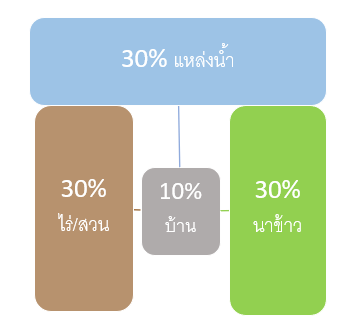
Allocation of Living and Farming Areas on the land plot for maximum benefit was calculated by King Rama IX, considering the average landholding of 15 rai per household. Thus, a rough formula for land allocation is: 5 rai for rice fields, 5 rai for vegetable gardens, 3 rai for a water reservoir 4 meters deep, holding approximately 19,000 cubic meters, sufficient for use during the dry season, and 2 rai for living space and other purposes, or according to the 30:30:30:10 ratio as follows:
- 30% = Water reservoir for water supply during the dry season, as well as for aquaculture and aquatic plants.
- 30% = Rice fields in the rainy season to provide sufficient food throughout the year and reduce expenses.
- 30% = Fruit trees, perennial plants, vegetables, field crops, medicinal plants, etc., for food, with any surplus available for sale.
- 10% = Living space, livestock, and other structures.
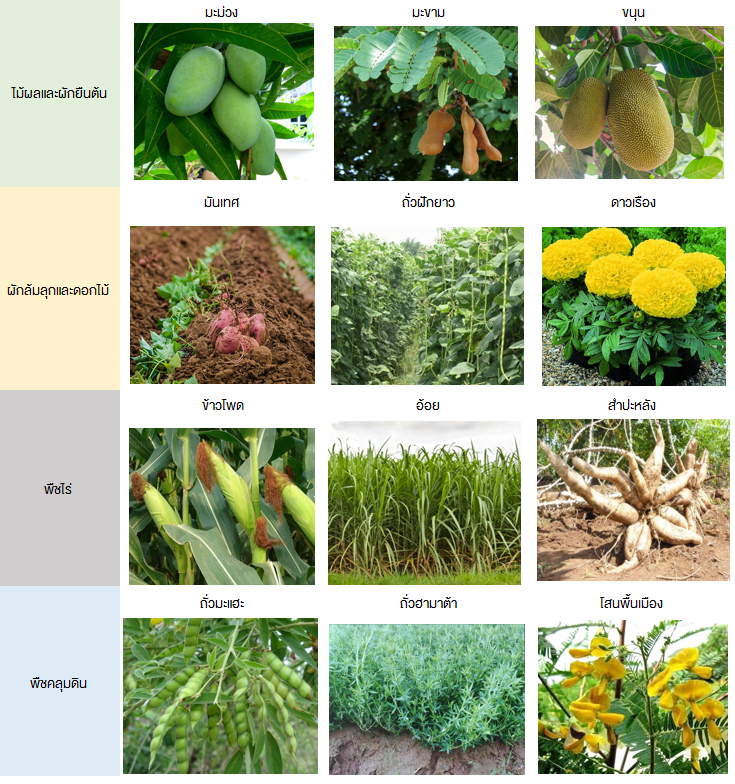
Types of Crops should be mixed for consumption, sale, or soil enrichment, such as fruit trees and perennial vegetables (mango, coconut, tamarind, jackfruit, etc.), annual vegetables and flowers (sweet potatoes, yardlong beans, marigolds, roses, etc.), mushroom groups, herbs and spices, utility and fuel plants (coconut, neem, rosewood, rubber tree, etc.), field crops (corn, soybeans, sugarcane, cassava, castor beans, cotton, etc.), as well as soil-enriching plants and ground cover plants (Mung bean, Hamata bean, African cowpea, native cowpea, etc.).
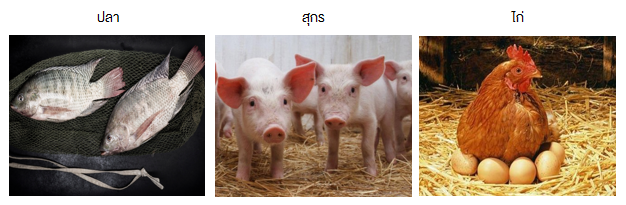
Types of Livestock such as fish (tilapia, catfish, etc.) for food and additional income, as well as pigs or chickens to use their manure as fish feed.
In conclusion, while implementing the New Theory is not easy due to varying soil conditions and water availability in different areas, some regions may have non-retentive soils like sandy or loamy soils, or may be unsuitable for planting due to acidic or saline soils. Therefore, it is advisable to consult agricultural experts in the respective areas, as well as consider the geographical conditions of those areas, such as the southern region, which has high rainfall, allowing for a reduction in the size of water reservoirs, etc. --- TerraBKK
Source: Chaipattana Foundation
Article by: TerraBKK Investment Tips
TerraBKK: Find good, valuable, and affordable homes