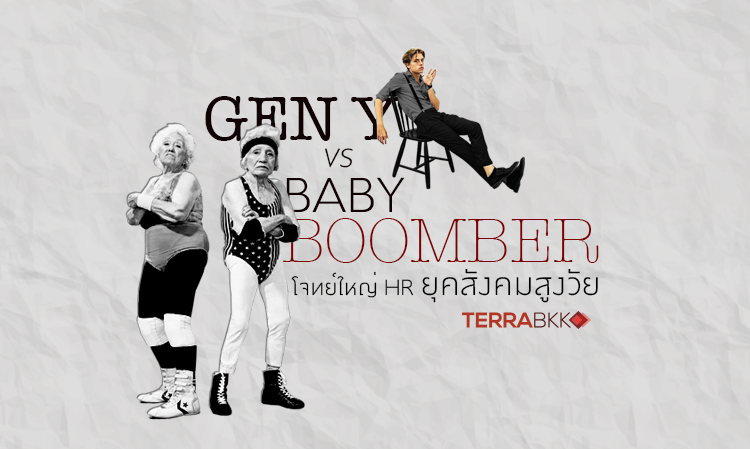
Generation Y vs Baby Boomers: The Major Challenge for HR in an Aging Society
As society begins to accept the reality that Thailand has entered an aging society, or simply put, we are fully in the era of the elderly taking charge, various sectors are rushing to adapt to the changing social trends. Particularly, businesses are quickly organizing to produce and develop products and services that cater to the elderly consumer group, yet they often overlook the internal challenges posed by their own changing workforce demographics.
Associate Professor Dr. Siriyupa Rungraengsuk, Deputy Director of Academic Affairs and Head of the Management Program at the Sasin School of Management, Chulalongkorn University, highlights the challenges of resource management in an era where everyone claims that Thailand is moving towards Thailand 4.0. During the 2017 Employer of the Year Awards, organized in collaboration with Aon Hewitt Thailand and Sasin, she pointed out that the current business landscape both regionally and globally is not only facing increased competition but also challenges arising from the aging society.
“Thailand has been considered an aging society for over 10 years now. The bad news is that in another 9 years, we will reach the highest level of aging society. The changing demographic structure will require organizations to adapt their workforce. In the future, we will see that the proportion of older employees will exceed that of employees under 30 years old. Furthermore, next year (2018), it is predicted that the working-age population in Thailand categorized as young adults will decline to a critical point,”
This situation has led many organizations to attempt to foster “Employee Engagement,” or the bond between employees and the organization. However, surveys assessing employee satisfaction across various organizations worldwide have shown consistently negative results. Focusing specifically on Southeast Asian countries (ASEAN), only 12% of employees feel engaged and want to stay with their current company for a long time, while 73% are searching for jobs on Google while working.
The changing job market has become a significant challenge for modern HR departments. According to a survey by Aon Hewitt Thailand, one of the major concerns that CEOs unanimously acknowledge as a source of stress, even waking them up in the middle of the night, is the issue of “people.” The stress ranges from whether they can hire new employees to whether the existing staff are truly skilled, as well as uncertainties in the process of developing new leaders from within the organization (Leadership Pipeline Development) and whether there are enough qualified candidates.
The question is, when “people” become a variable that cannot be ignored, how will organizations cope?
Associate Professor Dr. Siriyupa thoughtfully explains that the Thai government has announced since the beginning of the year that Thailand must move towards 4.0. However, based on research conducted at Sasin regarding Thailand in an aging society, we believe differently: that Thailand must move towards AGING 4.0, focusing on how to age gracefully.
“From now on, what will emerge in many organizations is diversity in the age of employees or Multi-Gen. On one hand, companies must welcome Generation Y as the new wave of employees, while at the same time, they need to extend the working age for older, experienced employees. Companies fear that if they let go of all older employees, they will lose skilled workers. The challenge that follows is how to manage two different age groups to work together harmoniously. It may sound easy, but if you think about it, even within a family, when older adults have to live with younger generations, there are often conflicts and differing opinions. So, when it comes to working together, the challenges for organizations will not only be about gender and cultural diversity but also age diversity,”
Certainly, the key leaders who will effectively manage people are not just HR professionals but organizational leaders with a vision for managing people, working alongside HR to establish systems, create environments, and foster organizational cultures that support achieving goals.
“This entire process is not just about creating a single solution; you must create an environment within the organization that drives it forward. This includes the working conditions, communication within the organization, branding, and employee care. Once the systems are in place, it is crucial to engage functional managers as allies because, although HR is responsible for hiring new employees, these individuals will ultimately be assigned to various departments under the supervision of functional managers. Managing Generation Y requires understanding that they are modern and impatient; they are not willing to work for 5 or 10 years just to see what their career path will be. Therefore, organizations need to act like insurance companies, showing clients what they will gain in 10-15 years,” concluded Associate Professor Dr. Siriyupa.