Khon Kaen Develops SMART CITY with Serious Private Sector Involvement
Time and again, TerraBKK has presented articles and content about urban development, as we believe that city-level development is significant in helping other sectors progress. Currently, many sectors are becoming more aware and placing greater importance on urban development, such as Khon Kaen province, which has driven urban development issues through Khon Kaen Think Tank – KKTT. This has resulted in the establishment of a city development company model and urban development approaches in other provinces across Thailand. Previously, TerraBKK highlighted the topic of Khon Kaen's urban development in articles like “Khon Kaen Development Model Without Relying on the Government” and “Chiang Mai, Phuket, Khon Kaen, Korat: Potential Provinces Ready for Electric Trains”. In less than a year, Khon Kaen has made clear and tangible strides in development. We will delve deeper into the urban development of Khon Kaen as we foresee that other major cities in Thailand will soon awaken and adopt the Khon Kaen Model.
Why Khon Kaen for Urban Development?
Khon Kaen province has a population of 1.8 million people (as of 2016) with a population growth rate of 2.09% per year, making it the fourth most populous province in the country. Additionally, Khon Kaen's central location in the Northeast makes it a hub for education, healthcare, and economic development in the region. These factors attract more residents each year, and the growth rate is notably high compared to other major provinces in the country. The rapidly growing city faces challenges such as pollution, traffic, public transport issues, social inequality, and income disparity. Relying solely on government budgets, which are often centrally distributed, is insufficient to address these problems.
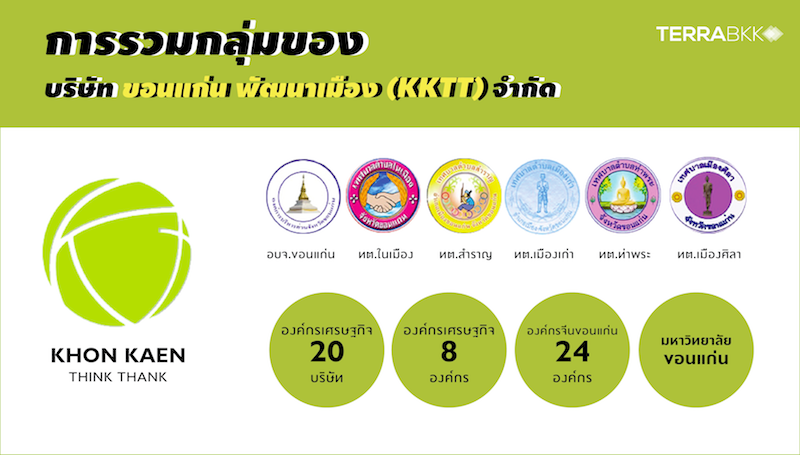
In 2013, business leaders in Khon Kaen came together to establish Khon Kaen Think Tank - KKTT with the aim of developing Khon Kaen into a thriving city. They collectively raised 200 million baht to establish a city development fund, managed by the company, which became a key player in driving the development of the Light Rail Transit system (LRT). They received funding to study suitable rail systems from the Office of Transport and Traffic Policy and Planning (OTP), leading to a master plan for the development of public transport in Khon Kaen, consisting of five lines covering five municipal areas. The government, led by the Prime Minister, signed off on the first route, Tha Phra-Samran, on June 10, 2015.
In March 2017, the Ministry of Interior approved the registration of five municipalities in Khon Kaen to establish Khon Kaen Transit System Co., Ltd. (KKTS) to manage and collect revenue from the public transport system.
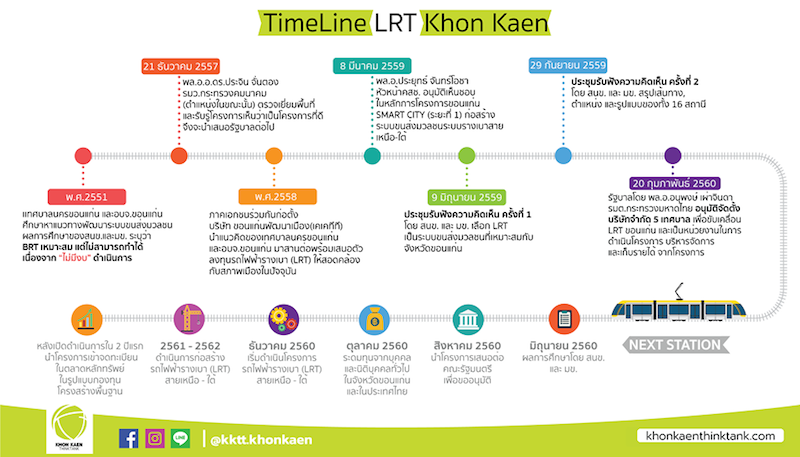
Image credit: http://www.khonkaenthinktank.com/
Khon Kaen Smart City
On March 8, 2016, the Prime Minister signed off on the “Smart City Project” for Khon Kaen, aligning with the national economic policy (Thailand 4.0). The development of a Smart City is included in the National Agenda Action Plan. Initially, one of the five-year indicators is to establish at least one successful model Smart City in a pilot area by 2018. The current approach to achieve this goal involves organizing competitions and training for the creation of at least ten model smart city development projects.
The international standards for a Smart City encompass six areas: Smart Mobility, Smart Living, Smart Citizen, Smart Economy, Smart Environment, and Smart Governance. Essentially, this involves developing infrastructure and technology to enhance convenience and ensure equitable access for the population.
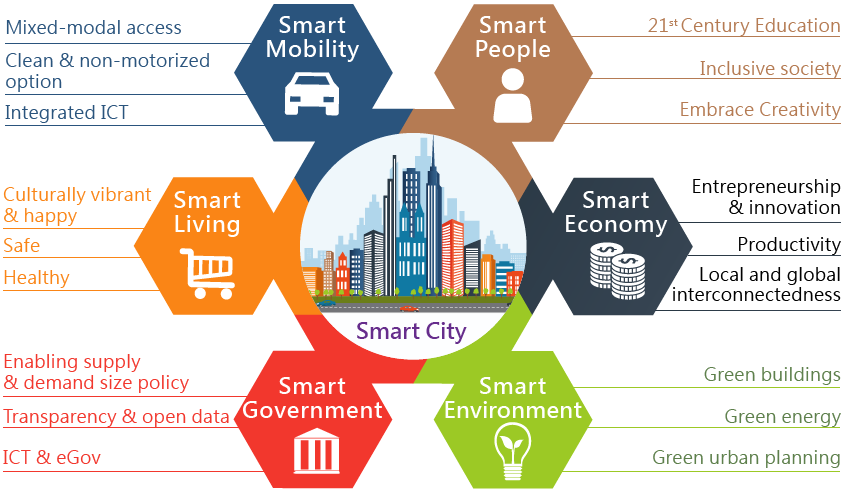
Image credit: https://smartcity.org.hk/index.php/aboutus/background
Public Transport Drives City
For Khon Kaen Think Tank, they believe that to transition the city to a Smart City, it is not necessary to be smart in every aspect. They have chosen Smart Mobility as the primary focus to transform the city into a Smart City, leveraging the development stemming from the LRT public transport system. The Transit-Oriented Development (TOD) plan aims to stimulate the economy and maximize land use around the transit stations, which is a concept that has yet to be clearly implemented in Thailand. Khon Kaen may be the first city to successfully achieve this, which is indeed exciting.
TerraBKK volunteers to guide readers in understanding TOD and the Smart City (Phase 1) of Khon Kaen in this article.
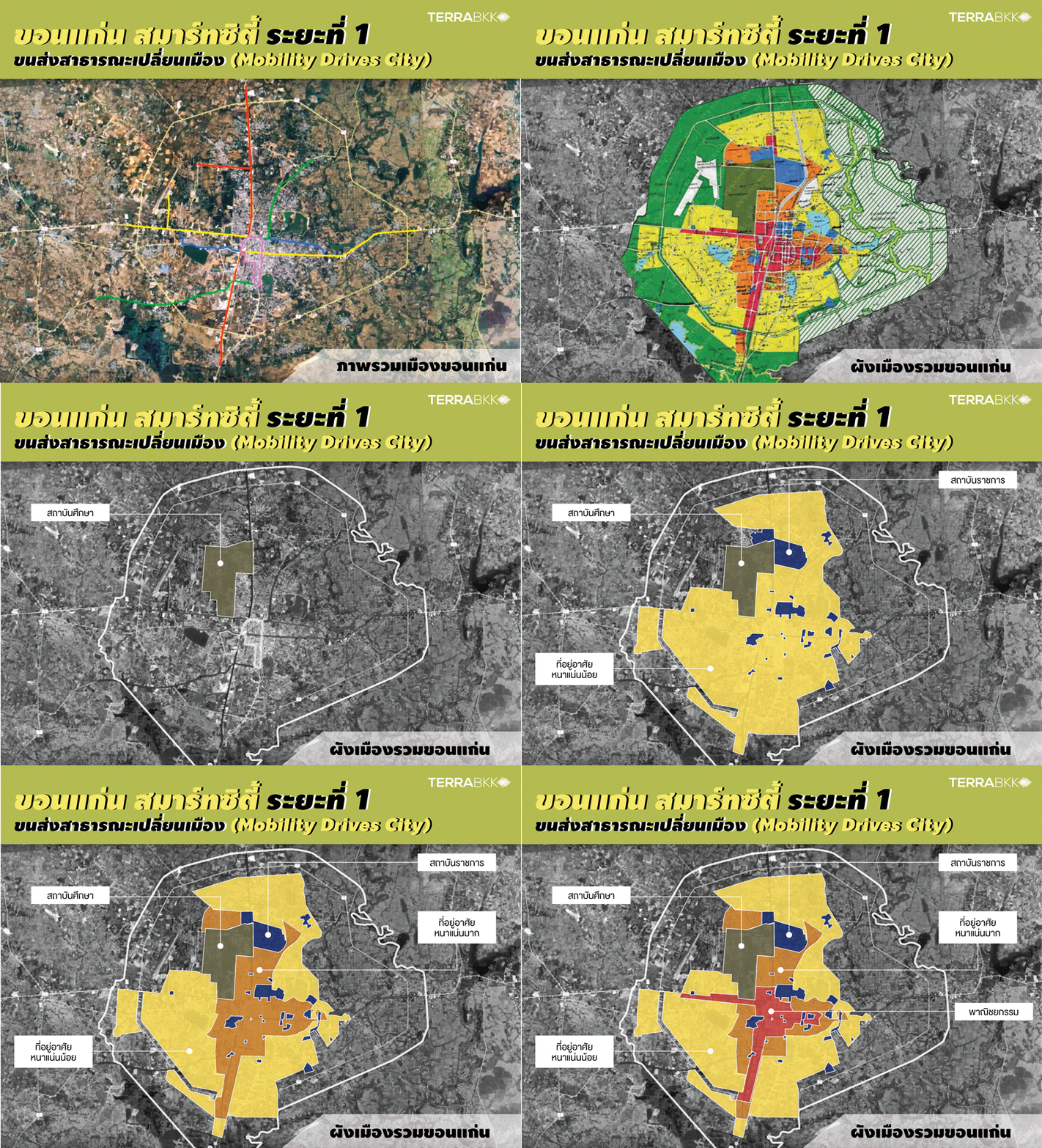
Khon Kaen's Master Plan features a central Central Business District (CBD) surrounded by agricultural and conservation areas, similar to the Garden City concept, which includes green spaces at the city’s periphery to prevent uncontrolled urban sprawl that could encroach on green areas. This urban planning approach tends to concentrate development in the city center, making it easier to create a Compact City without needing to disperse infrastructure development budgets.
The essence of this urban planning will impact the development of the rail public transport system and the areas around the transit stations (TOD), which we will explain in the next paragraph.
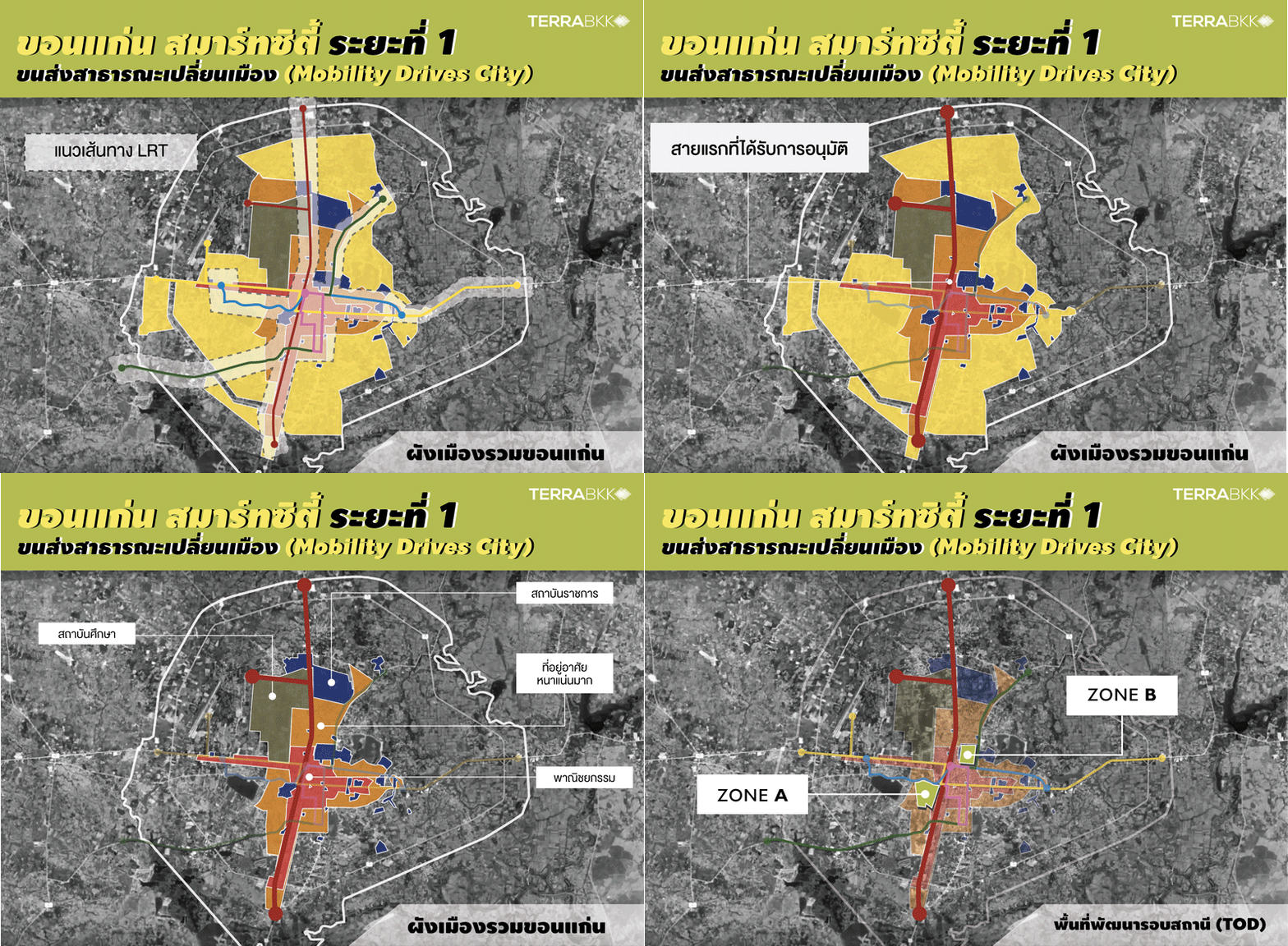
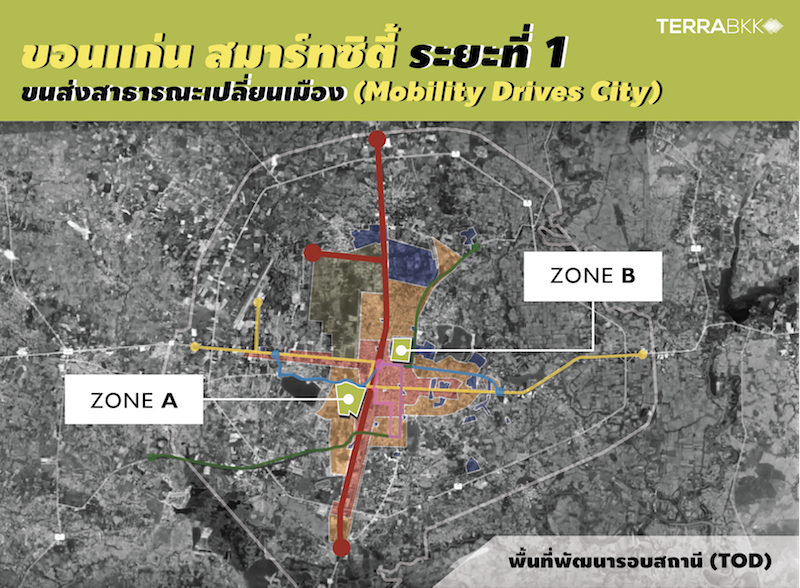
Public Transport Development Plan using Light Rail Transit (LRT) in Khon Kaen consists of five lines, all with interchange centers located in the CBD as per the master plan (red commercial zone). It is highly likely that development will concentrate in the city center. The first approved construction line is the North-South Red Line (Samran-Tha Phra), which passes through important areas including commercial, densely populated residential areas, educational institutions, and government offices.
With interchanges converging at a single point for all five LRT lines, the surrounding areas can be fully developed. The TOD development plan for Khon Kaen has designated two areas: Zone A: New City Area and Zone B: Revitalization of the City Center, as shown in the image, accessible by both the LRT and roads.
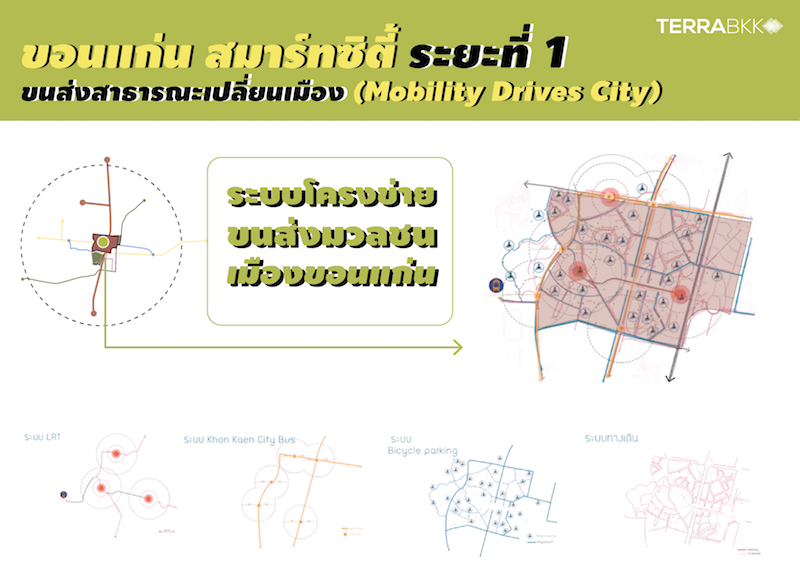
The public transport network in Khon Kaen has a well-organized and clear allocation of each travel mode. Each zone surrounding the public transport system has defined roles to encourage activities around the LRT stations, aligning with routes for LRT, city buses, pedestrian pathways, and bicycle parking. Each service point for each mode is within a 400-meter walking distance, adhering to the neighborhood city concept with good accessibility. Additionally, it allows for equitable and comprehensive distribution of transfer points (NODES) around the city center.

Khon Kaen Smart City: How Smart is it?
For the areas around the stations (TOD) in Khon Kaen, the design encompasses all five LRT lines, dividing land use to promote urban activities. The building use areas are categorized into commercial, low-rise and high-rise residential, government institutions, transport interchange areas, and recreational spaces, which can be adapted for diverse business and land use. This is quite interesting because if this plan succeeds, Khon Kaen will have the best public transport system and station area design in Thailand.
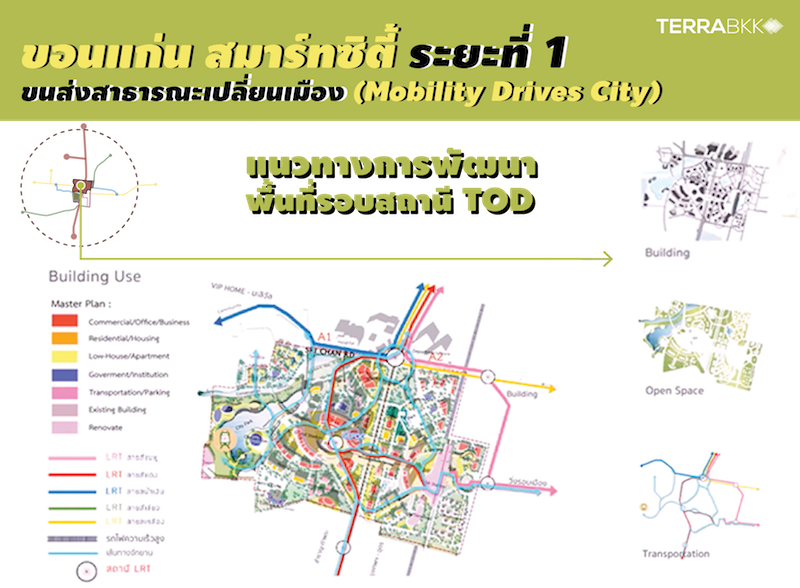
After developing the areas around the stations, this will undoubtedly become the CBD of the city. However, it may not resemble Silom-Sathorn, which is the CBD of Bangkok, as Silom-Sathorn has a clear role primarily as a job hub. Additionally, the scale of the population between Bangkok and Khon Kaen differs significantly, which means that the CBD of Khon Kaen will be genuinely accessible to the urban population. As traffic increases, further development towards becoming a Smart City will follow.
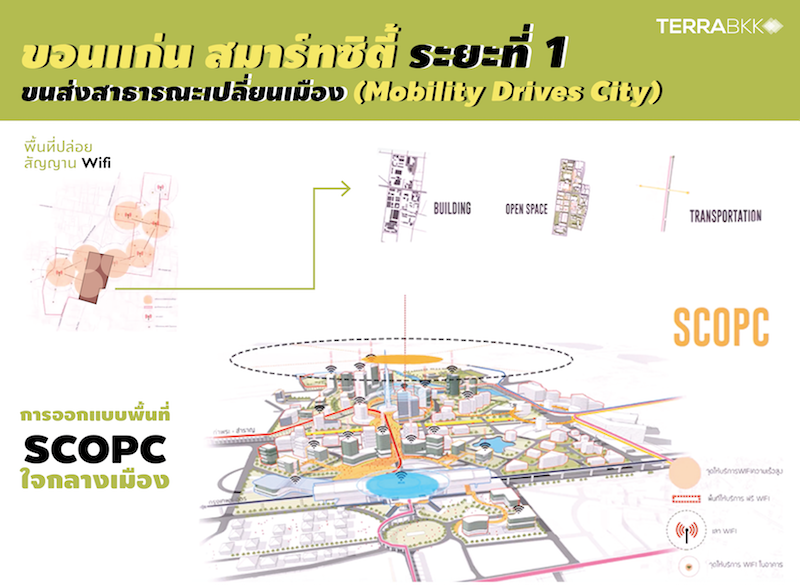
The Khon Kaen Smart City project utilizes the TOD areas as points for installing various technologies, focusing on Smart Mobility. There is a master plan to develop the Smart City Operation Center (SCOPC) to create a concrete center for technological development in Khon Kaen, employing Internet of Things (IoT) and Cloud-Based systems for data storage and analysis. The development of these areas will begin in ZONE A: New City Development Area and ZONE B: Revitalization of the City Center.
In addition to the points presented by TerraBKK, the key aspects of the master plan for the Khon Kaen Smart City Project (Phase 1): Public Transport Drives City from the Khon Kaen Think Tank and all Khon Kaen residents include many other interesting development issues. Recently, this project was one of seven finalists in the Smart City-Clean Energy design support project organized by the Ministry of Energy in collaboration with the Green Building Foundation. Other finalists are not urban development projects like Khon Kaen, so it must be acknowledged that Khon Kaen has taken significant steps ahead of other provinces in Thailand regarding urban development.
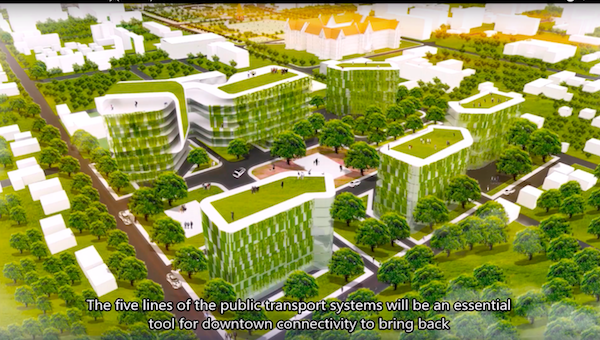
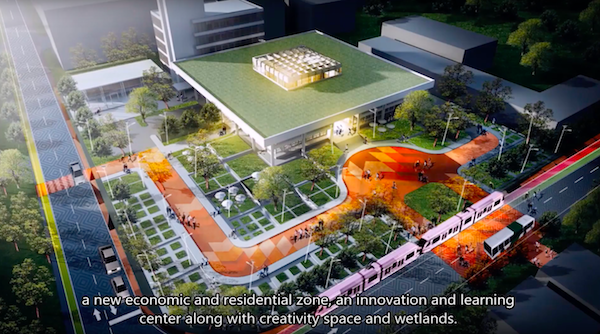
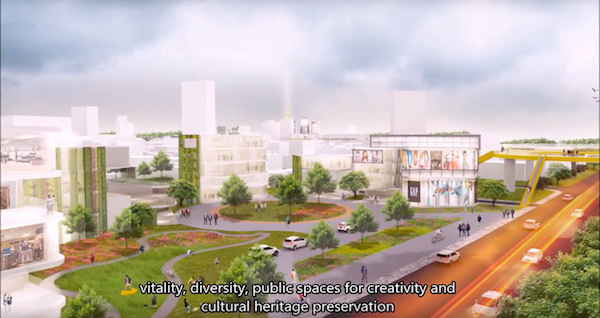
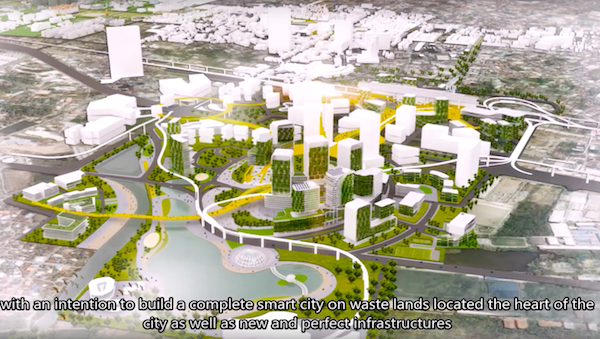
For those interested in following news and developments in Khon Kaen, you can visit http://www.khonkaenthinktank.com/ and watch the Khon Kaen Smart City project video at https://youtu.be/SEonM8vf7ng
Article by: TerraBKK Knowledge Base
TerraBKK: Find good homes, value for money, and affordable prices