
How Far Can the SET Go?
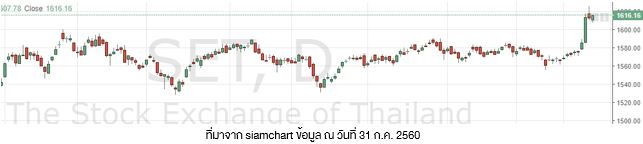
Many people may feel uncomfortable with the quiet atmosphere of the Thai stock market, which still lacks a clear direction. Since the beginning of 2017, the Thai stock index has been fluctuating within the range of 1530-1600 points, unlike foreign markets that have shown clearer upward and downward trends. However, on August 29, the SET index made a surprising move by breaking through the 1600 mark, closing at 1613 points with a trading volume of 96 billion baht, the highest in a year.
Does the overall net profit of the market affect the stock index?
As is generally known, a company's revenue and profit drive its growth in terms of business operations and stock prices in the market. TerraBKK Research has gathered data on the overall net profit of the stock exchange to compare it with the movements of the SET index over the past fifteen years.
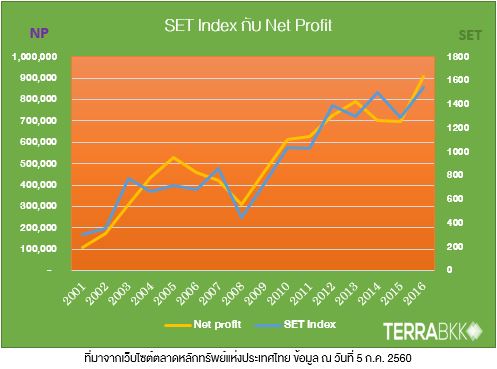
The data shows that the overall net profit of the market tends to move in the same direction as the index almost all the time in the long term. There may be periods when the total profit rises significantly, but the SET index does not follow suit, such as during 2004-2006. This could be due to long-term profit contraction and global terrorism chaos, as well as political instability in the country, which affected the country's economic factors, causing the index to fluctuate for a while. However, overall, it can be concluded that profit figures are a crucial factor that enables the market to rise effectively.
*The overall net profit of the market refers to the total net profit from companies listed in the SET across all 8 industrial sectors.
*EPS is the portion of net profit allocated to each common share, calculated as follows:
Earnings per share = Net profit of the company / Number of issued common shares.
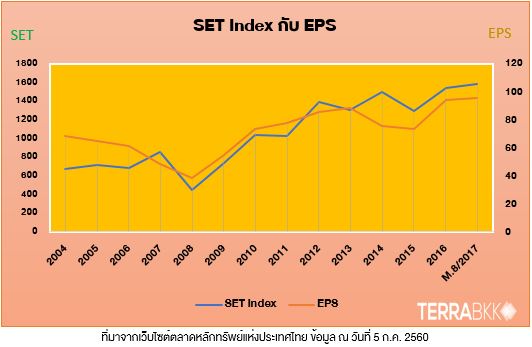
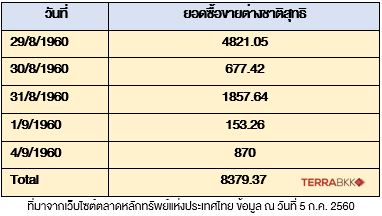
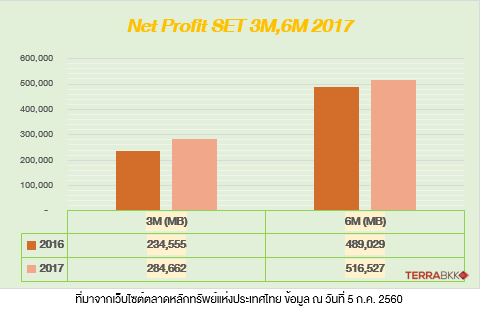
When incorporating the earnings per share data for the first 8 months of 2017, it was found that the current earnings per share for 2017 is 95.48, slightly higher than the earnings per share at the end of 2016, which was 93.71. It is possible that by the end of this year, we may see the overall market profit increase further. Looking at the quarterly and half-year profit figures in detail, comparing 2016 and 2017, the first quarter grew from 234 billion baht to 284 billion baht, an increase of about 20%. The half-year figures grew from 489 billion baht to 516 billion baht, an increase of about 5%, which is not significant. Therefore, if the SET index is to continue this year, we must hope for good profit figures in the second half of the year. The fact that the index has broken through the 1600 mark indicates a positive outlook from investors for the second half of the year. The end of the year is typically a high season for consumer spending and tourism. Additionally, foreign investor trading data shows a net buying of approximately 8.4 billion baht over 5 consecutive days (August 29 - September 4, 2017), despite a net selling of 4.6 billion baht for the year up to that point (January 4 - August 28, 2017), resulting in a turnaround in foreign investor trading to a positive 3.8 billion baht, reflecting the return of foreign capital to invest in the Thai stock market.
Which industrial sectors are still interesting?
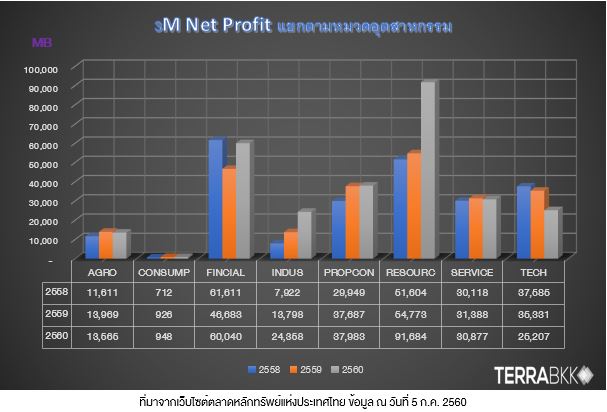
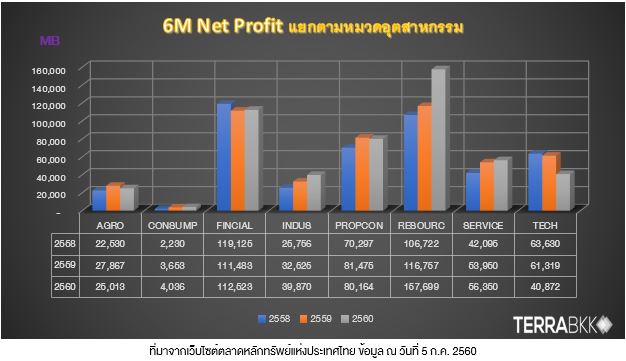
We continue to look at which industrial sectors have shown clear net profit growth over the past two years. By comparing net profit data by industrial sector on a quarterly and half-year basis from 2015 to 2017, it can be seen that the sectors with outstanding profit growth trends are the energy sector, which grew by 50% over two years, and the industrial products sector, which also grew by 50% on a half-year basis, primarily driven by petrochemical and chemical companies.
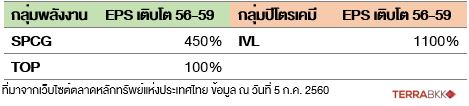
The stocks with continuously growing earnings per share in the energy sector include SPCG and TOP, while in the petrochemical and chemical sector, they include IVL.
Meanwhile, the sectors with relatively stable profit figures are the financial sector and the real estate and construction sector. If these two sectors improve their profit figures, it would provide strong support for the overall market. Starting with the banking sector, the main factor holding back growth and causing concerns about the expansion of banks in Thailand is the NPL (Non-Performing Loan) figures, which require good management policies from both the government and the banks themselves. In the real estate and construction sector, there are currently driving factors such as various infrastructure projects related to area development and transportation, valued at several hundred billion baht, which will lead to increased demand for housing. This has prompted real estate developers to seek partnerships with foreign investors, as clearly seen in the past two years. If the overall performance of companies in these two sectors begins to recover positively, it will further enhance the overall market profit, as both sectors have relatively high company valuations.
*NPL refers to loans that are suspected to be uncollectible and cannot recover assets.
How Far Can the SET Go?
When considering whether a company's stock is good, one common method is to compare it with other stocks within the same industry. The stock exchange is no different; when assessing various possibilities, comparisons must be made with countries in the same region. TerraBKK has compiled index and earnings per share data from neighboring countries such as Indonesia, the Philippines, and Malaysia from 2004 to 2016 for comparison. It can be seen that the growth patterns of profits and indices are closely related, and the trends of the indices in the past have been quite similar to that of the Thai stock market.
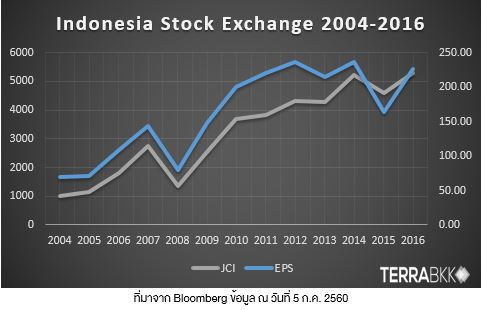
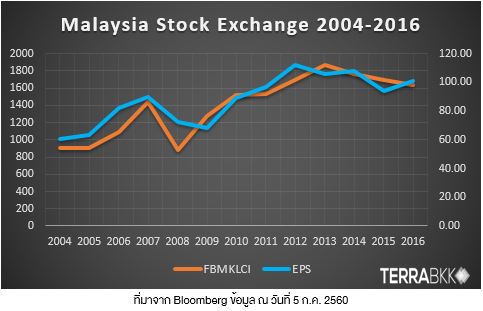
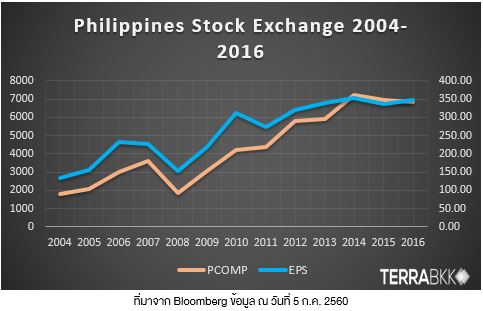
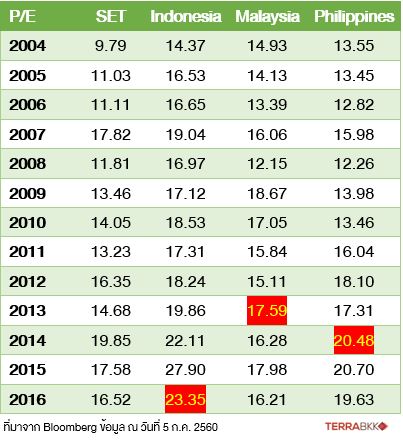
We also look at the P/E ratios of each market, which are generally used in analysis to reflect the valuation of a company or stock market and also indicate growth potential. It can be seen that over the past 13 years, the three neighboring markets had their indices peak between 2013 and 2016, with P/E ratios at the peak of the Indonesian, Philippine, and Malaysian markets being 23.35, 20.48, and 17.59, respectively. As of July 5, 2017, the Thai stock market index was around 1620 points with a P/E ratio of 16.9. Compared to neighboring markets trading at P/E ratios over 20, there is potential for the Thai stock market to continue rising if supported by favorable factors.
*P/E of the stock market is the ratio of the stock market index to the earnings per share of the overall market.
Finally, TerraBKK Research believes that Thailand remains an interesting emerging market for investment, as there are still many businesses capable of expanding production and growth, and can grow annually at a rate higher than developed countries. Therefore, if various economic factors begin to recover positively, leading to effective growth in profits of listed companies, it will attract foreign capital, which is a key driving factor for the stock market to return. However, it must also be complemented by the stability of the country's political situation.