Is it true that living in a condo near the BTS allows you to wake up late?
"Are we really in an era where we have to take the BTS back <\/em>4-5 stations just to get on?"<\/em>
"Wow, I waited for the subway <\/em>5 trains before I could go!"<\/em>
"Queuing for the BTS feels like fighting for free giveaways!"<\/em>
Every morning in the office, conversations inevitably revolve around last night's dramas, news updates, and the highlight of the day is "the traffic conditions this morning."<\/strong> Believe it or not, people in Bangkok spend an average of 2-3 hours commuting to work each day. Some have resorted to buying condos near the BTS so they can wake up late and reach work quickly. However, life isn't as glamorous as it seems because in reality, we often have to wait for several trains just to squeeze ourselves in! (Not to mention the time lost when the BTS malfunctions, trains break down, or traffic management issues arise... but let's skip those as they don't happen often.)
What time should you leave to catch an empty train?
According to the TerraBKK team, based on various threads and inquiries from people who take the BTS/MRT to work, they all agree that the period between 6-7 AM is when the trains are spacious and comfortable, without competition. After 8 AM or during rush hour, it becomes quite challenging. This means that no matter where you live, whether close or far, if you dislike competition, it's best to arrive at the BTS station by around 7 AM.
What about the problematic extensions?
We see news every day about the extensions of this or that line set to open in 256X. People in those areas can only wait eagerly for the day when the BTS is completed so they can commute comfortably. However, the addition of extensions significantly increases the number of passengers. Even with more trains, it still doesn't match the number of passengers, meaning it hardly alleviates the congestion at all.
For example, the recently connected Purple and Blue MRT lines. Anyone who has to board the train along the Ratchada area knows this pain well. Some say the train is full from Bang Sue, while others argue it's full from Bang Yai. This could be a new selling point for condos along the Purple line, allowing residents to ride comfortably from the starting point. However, it becomes a misfortune for those boarding from Bang Sue to the Cultural Center, as it isn't until around Rama 9 or Asoke that the crowd starts to thin out. We find ourselves needing to ride back to the starting point just to board the BTS, even though the condo is just a reach away from the station.
The same goes for the BTS, especially the Sukhumvit line from Bearing to Samrong, which has been packed since Bearing. By the time people get off, it's almost at Phrom Phong, as there aren't many offices along that route. Even the Silom line faces bottlenecks at Taksin station, waiting for trains to switch lines. Not only do we wait for trains heading into the city, but we also have to wait for trains going the other way. This paints a picture for those considering buying a condo near the BTS with the hope of waking up late and commuting comfortably—they may need to rethink and choose their station carefully.
Is living in a condo near the BTS really comfortable?
In this case, we won't compare condos near the BTS with houses in the suburbs, as it's clear that condos near the BTS save time driving or commuting to the BTS station. However, the term "condo near the BTS" does not mean any station will do. It must be a station that is convenient for commuting to work. But what is considered "convenient" varies from person to person. Some may prefer to board comfortably at the starting point but pay a high fare, while others may be okay with waking up a bit earlier and squeezing in for just a few stations. TerraBKK Research offers three choices, each with its pros and cons:
1. Condos at the starting point: Comfortable ride, high fare
If you don't want to squeeze in with others, solve the problem by buying a condo right at the starting point. You can ride comfortably from the beginning without competing with others along the way. The advantage of condos at the starting point is that they are often not too expensive, as they are located in suburban areas, but the fare can be high. Examples of such stations include Bang Yai, Bang Wa, and Pak Nam-Samrong.
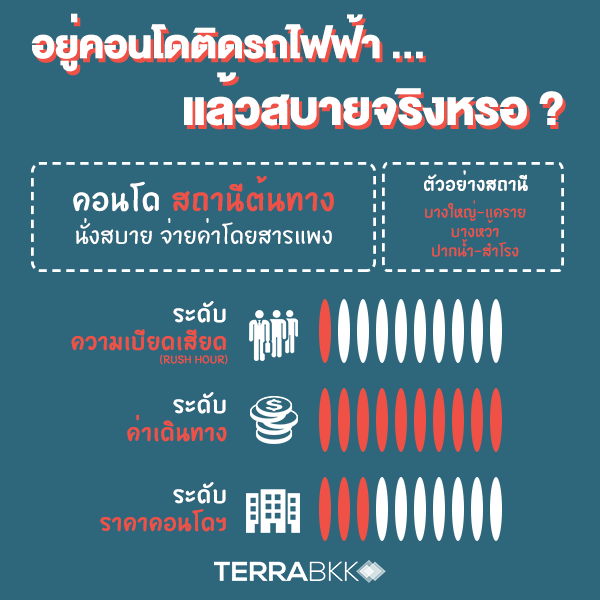
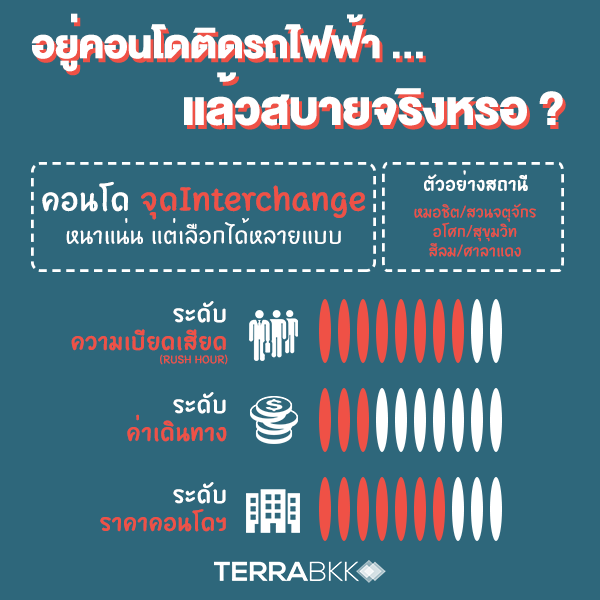
2. Condos at Interchange points: Crowded but multiple travel options
Another option for those with a higher budget is condos at various Interchange points, whether it's an interchange with other BTS lines or with other transport systems. The advantage of these Interchange points is that you can travel in multiple ways—if the BTS is down, you can take the MRT, and vice versa. However, these condos tend to be more expensive. Examples include Mo Chit/Jatujak, Asoke/Sukhumvit, and Silom/Sala Daeng. But stations connected to extensions can be quite daunting as they bear the full brunt of passenger numbers, so caution is advised when choosing a station.
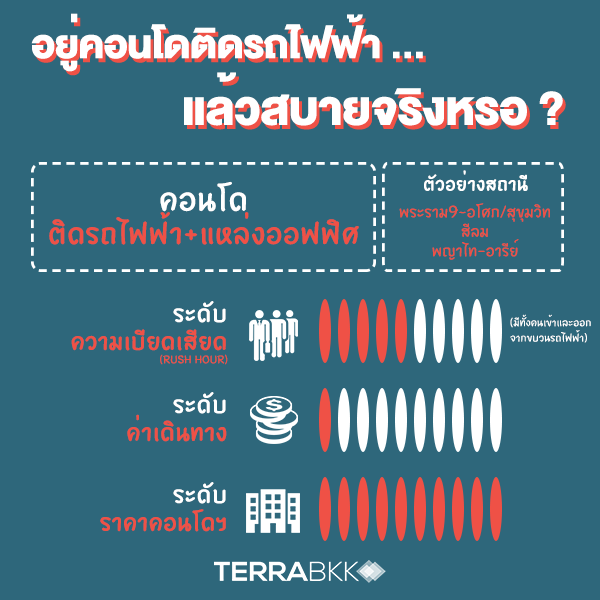
3. Condos near the BTS and surrounded by offices
For those with enough funds to buy a condo, TerraBKK recommends purchasing a condo that is near the BTS and surrounded by offices. This is because these stations tend to have a portion of passengers already dispersed, as they are office hubs, leading to more people getting on and off the trains. This is unlike stations in the middle of the line where there are no offices, resulting in fewer people getting off. However, the downside of these condos is that they are often very expensive, such as those near Sukhumvit, Silom, and Rama 9.
If our country does not improve the public transport system, which currently leads to severe traffic jams whether driving or taking the bus, using the BTS which should be the most punctual transportation system, is not the case. The extensions that have been added do not significantly solve the problem, as the number of passengers increases but the number of trains does not keep pace with the volume of people... So, can I choose something else? ... People in Bangkok still have to reluctantly use these services, wasting over 60 hours a month on commuting. We can only wait for the relevant parties to seriously reform the public transport system - TERRABKK
Article by: TerraBKK Knowledge Base
TerraBKK: Find good, valuable, and affordable homes