
What is the Neighborhood We Live In? (According to Urban Planning Theory)
If we were to discuss the topic of “location” and what makes a location good, the criteria for decision-making would likely revolve around accessibility to public transport, roads, highways, shopping centers, and other amenities. But did you know that in urban planning, there is a theory for designing a good “neighborhood”? This concept was introduced by Clarence Perry in the 1920s, nearly a hundred years ago, under the name “The Neighborhood Unit”, which is the smallest residential community unit, typically within a radius of about 1 mile or 1.7 km.
The concept of “Neighborhood Unit” is a community design principle based on the relationships between urban elements. It should allow for convenient walking within a 5-minute timeframe (or a distance of 1 mile), meaning this concept is intended to support small communities or neighborhoods that have more community elements than just housing.
Of course, the original idea of Clarence Perry, which emerged before the industrial revolution, did not account for the rise of automobiles. By the late 1980s to 1990s, the phenomenon and concept of Urbanism emerged, as cities began to grow and diversify, leading to a pattern of suburbanization with multiple sub-centers. The design of residential developments during this period began to include Cul-de-sacs, where the ends of main roads in communities are circular, allowing access to several homes.
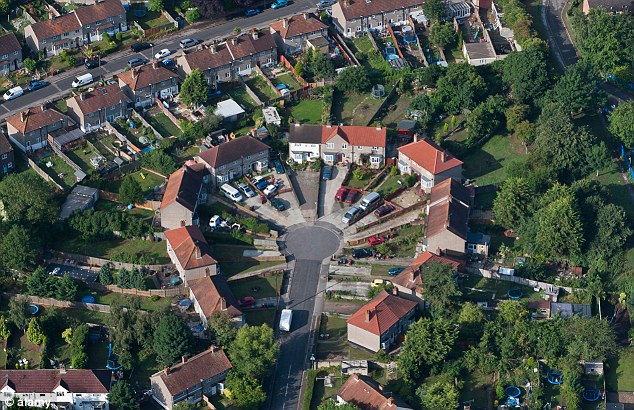
Neighborhood Unit refers to a community area that includes elementary schools, small shopping centers, parks, and residential areas, which are fundamental requirements for human quality of life, encompassing learning - playing - consuming - resting. The roads leading into residential zones during that time typically featured cul-de-sac designs, while the main street of this concept connects neighborhoods and is located on the outskirts, with internal roads being smaller streets that do not prioritize vehicle traffic.
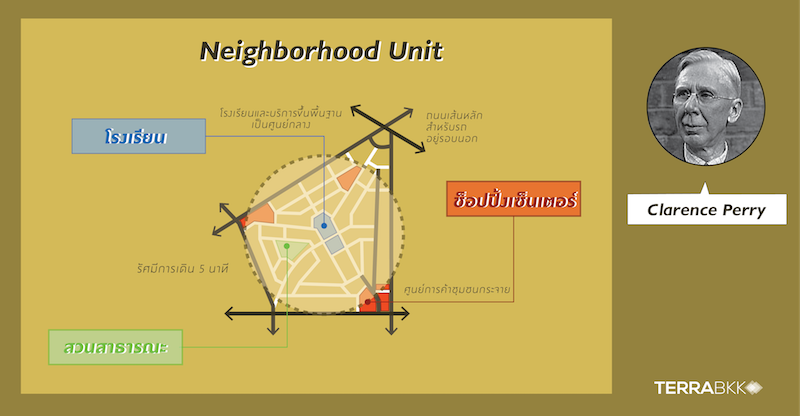
As times changed, the concept and design of the Neighborhood Unit have been developed and modified twice, in 1994 (Duany Plater-Zyberk) and 2007 (Douglas Farr). However, the overall characteristics still largely reflect the original version, influenced by factors such as road networks, public services, population size, household size and density, and walkability, to ensure accessibility within the neighborhood according to the concept of “within 5 minutes”.
Which areas in Bangkok qualify as Neighborhood Units?
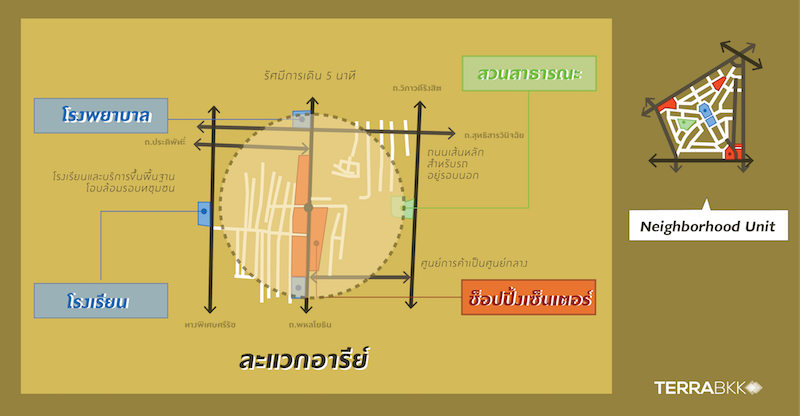
In Bangkok, there are several areas where amenities can be reached within 5 minutes, such as Silom-Sathorn, Siam, Samyan, Phahurat, Charoenkrung, Thonglor-Ekkamai, and the beginning of Sukhumvit. However, due to high land prices in some locations, low-rise housing is not commonly found. When comparing directly with the Neighborhood Unit concept, we see that Ari has clear community elements, including:
- Commercial center - serving a population of approximately 7,500 to 20,000 people.
- Educational institutions - accommodating about 1,000 to 4,000 students.
- Hospitals - with 200 to 500 beds.
- Main road network - Phaholyothin Road, Vibhavadi Rangsit Road, and Si Rat Expressway.
- Secondary road network - Pradiphat Road, Sutthisan Winitchai Road.
- Internal community road network - Phaholyothin Soi and Pradiphat Soi.
- Public transport - buses, motorcycle taxis, and the Green Line Skytrain.
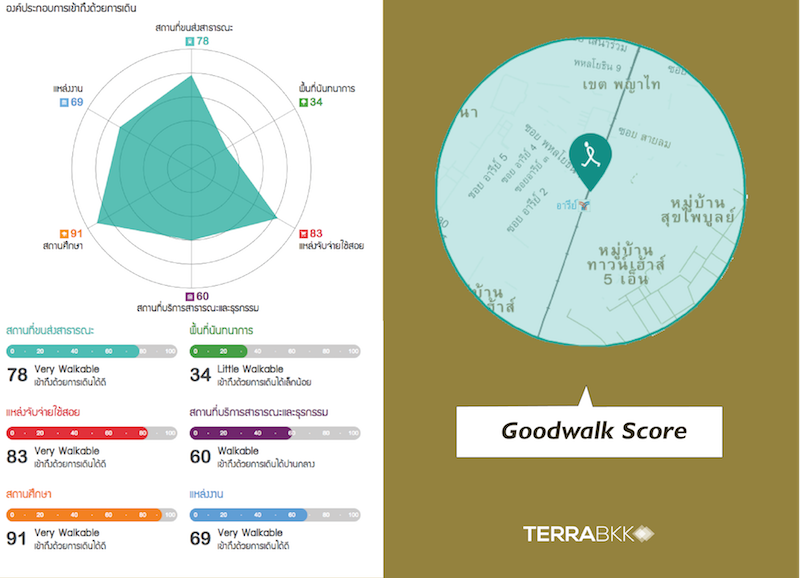
If you want to know whether your neighborhood fits the Neighborhood Unit theory, try walking from your home to the nearest shopping center or public transport this evening. If you don’t feel overly tired and think you could walk further, that’s the result. Alternatively, you can check walking distances at http://www.goodwalk.org/ - เทอร์ร่า บีเคเค
Article by: TerraBKK Knowledge Base
TerraBkk: Find good, valuable, affordable homes