The War for Talent: International Competition for Labor
The last war that humanity faced occurred over 70 years ago. Today, the power held by the elite is no longer in weaponry but in the competition for data resources and networks. Prominent figures of our time, such as Mark Zuckerberg, the king of social networks, and Jack Ma, the influential figure in China and founder of the e-commerce giant Alibaba, both control some of the largest data resources and networks.
However, we are about to discuss the impending war for resources that will undoubtedly arise in the next 20 years, which is the competition for human resources. Many research studies suggest that in 20 years, the global population will have higher education levels. The catalyst for this change is the ability to access data networks like the internet, with an average of 3 GB of data accessed daily per user in the future. This is evident from the online encyclopedia Wikipedia, which launched in 2001 and saw an increase of 3.5 million articles by 2011. The openness of this knowledge repository will raise the global primary education rate from the current 88% to 91% and secondary education completion from 50% to 55% in the next 20 years.
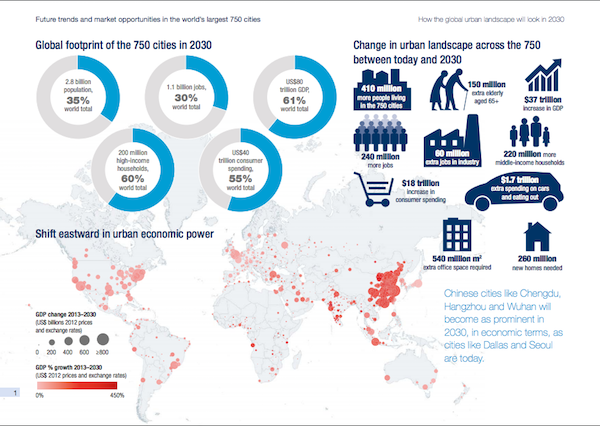
Future trends and market opportunities in the world's largest 750 cities: How the global urban landscape will look in 2030, Oxford Economics
Brain Gain & Brain Drain
By 2030, or in 20 years, many changes are expected in demographics, economy, technology, and importantly, employment. It is anticipated that 58.6 million employees will change jobs between 2010 and 2030 due to the retirement of a large number of Baby Boomers. However, there will be over 90 million job vacancies, with one-third being new positions. These vacancies will not remain unfilled for long, as they will be replaced by skilled labor from around the world, which is more advanced than previous generations. Despite the abundance of job openings, many countries still face labor shortages because the qualifications for these positions are higher than before, particularly in engineering and healthcare sectors.
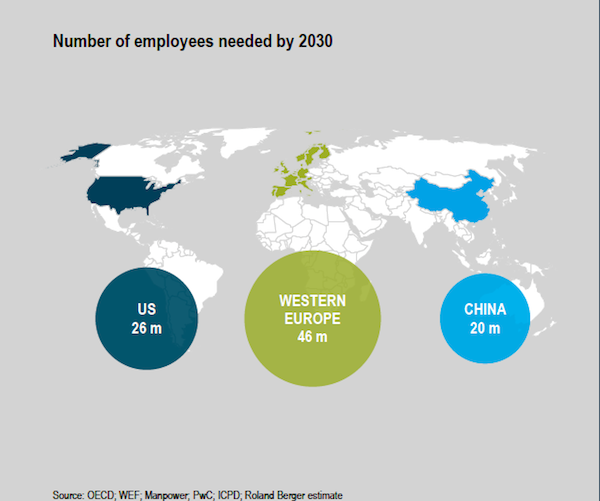
Image from: Trend Compendium 2030, Roland Berger
The consequence is the migration of labor or brain drain from each country. High-quality human capital will migrate to countries with better working and living conditions, leading to a situation of brain drain on an international scale. It is expected that the number of people working internationally will grow by 50% in the next 20 years, prompting many large organizations worldwide to develop new hiring strategies that are not limited to any specific nationality. They are strengthening relationships and supporting various universities to attract new labor groups entering the market in the future, to accommodate the expanding limits of innovation and technology that will become a crucial competitive factor in the business world.
What Humans Do Better Than AI Is Only Selling
Researchers from Oxford University have hinted that in the near future, algorithms and artificial intelligence will have the potential to replace 97-99% of jobs in the real estate sector. The development of AI will elevate real estate beyond just “selling”, and professions like brokers or salespeople may find themselves in a precarious position. Additionally, demographic changes and consumer behavior will directly impact job positions, skills, and business models in real estate. The increasing population, coupled with labor migration, will lead to rapid urban development. A report from McKinsey (2014) indicates that urban populations capable of generating income will reach 1.6 billion, creating adequate housing by 2025. One emerging trend is the sharing economy in real estate, which could generate $330 billion, particularly through sharing office space during unused hours, which will undoubtedly capture a significant market share in real estate in the near future.
There are numerous factors that will impact the structure of the real estate business, including AI's ability to work faster, safer, and more accurately than humans, and the changes in economic platform systems that will alter employment and organizational structures. The skills that will be increasingly sought after in the future will include service jobs, technical jobs, and healthcare roles, among others.
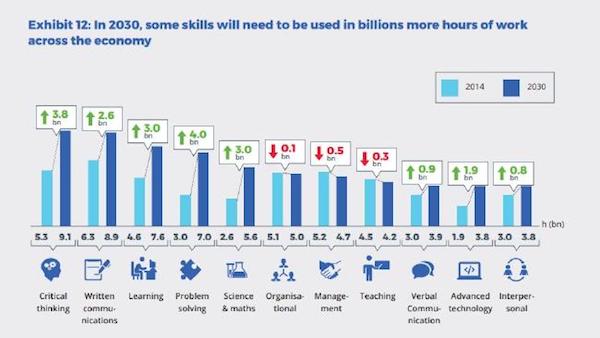
Image from: http://www.news.com.au/
Article by: TerraBKK Investment Tips
TerraBKK: Find good, valuable, and affordable homes