A Look at the Global Economy in 2050
Imagining the world 33 years from now is quite a challenge, especially when considering what will happen in 2050. Who can accurately predict global scenarios 30-40 years into the future? However, we must acknowledge that while these forecasts may not be 100% accurate, they at least provide a reasonable perspective on future trends, whether it be economic figures, population growth projects, or shifts in economic power. Notably, China will no longer be the most populous country. Price Waterhouse Coopers (PwC), a leading global consulting firm, has projected the economic figures for various countries in 2050, highlighting several interesting points:
Highlights
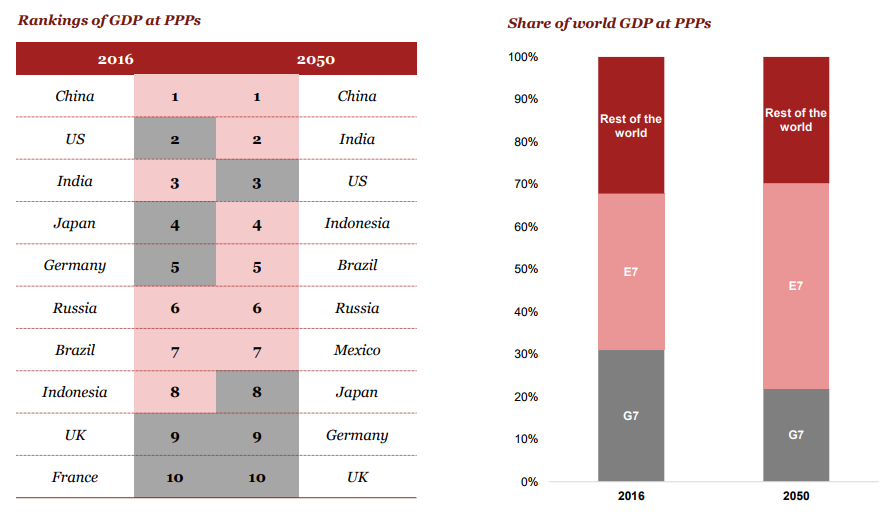
- The Emerging Economies (E7) will surpass the Advanced Economies (G7)
- India will surpass the United States to become the world's number 2
- Vietnam, India, and Bangladesh will become the countries with the highest GDP growth!
- Thailand will be surpassed by Vietnam, the Philippines, and Bangladesh
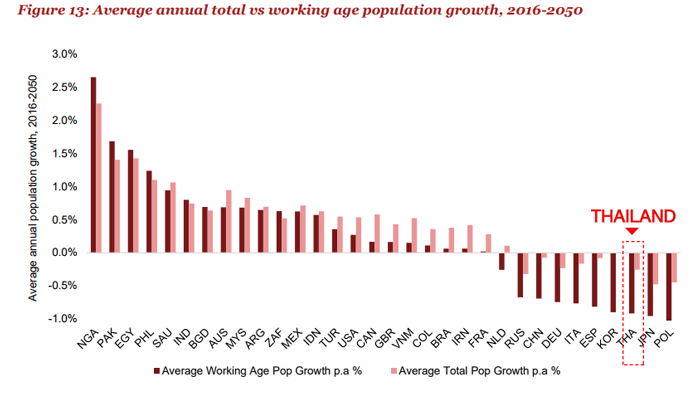
- Population growth rates in China and Thailand are expected to decline

The E7 Group Surpassing the G7
To clarify, the G7 and E7 groups refer to different sets of countries. The G7 consists of the world's leading industrialized nations, namely the United States, Japan, Germany, the United Kingdom, France, Italy, and Canada. By 2050, it is predicted that these seven countries will be surpassed by the seven emerging economies (E7), which include China, India, Indonesia, Brazil, Russia (formerly part of the G7), Mexico, and Turkey.
- The E7 group will account for nearly 50% of global GDP
- India, Indonesia, Brazil, and Mexico will surpass the G7, with the U.S. dropping to third place
- Thailand will rank 25th in 2050, down from 20th in 2016
Source: The World in 2050, PwC, February 2017
Vietnam, India, and Bangladesh are the countries with the highest GDP growth!
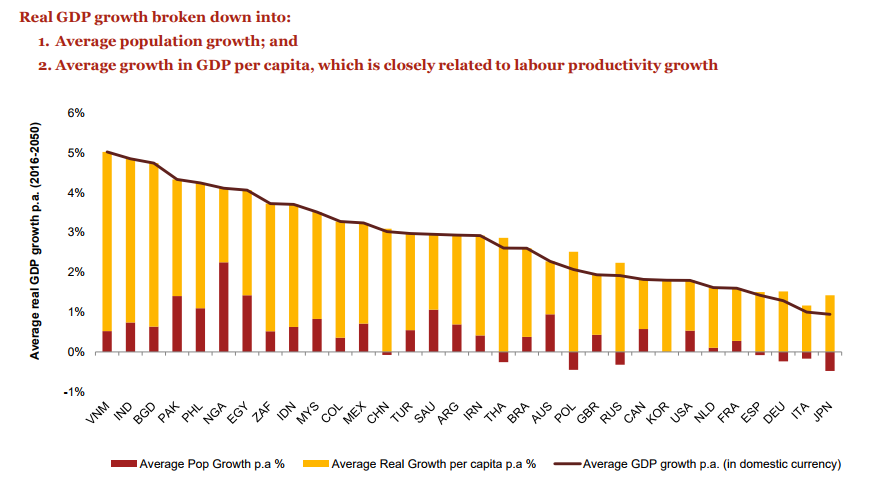
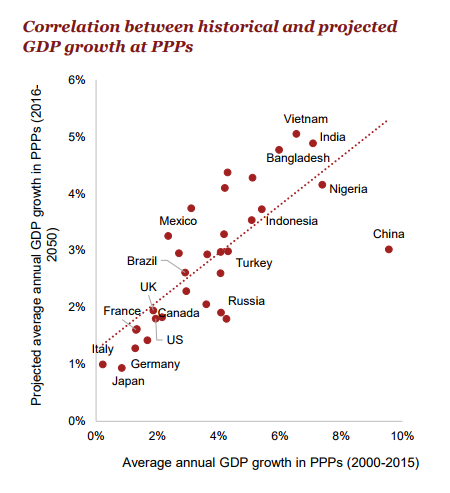
By 2050, the global economy will see dark horses like Vietnam emerging as the fastest-growing country, with a GDP growth rate of 5% per year, followed closely by India at 4.9% and Bangladesh at 4.8%.
- The top 15 countries with the highest GDP growth are all developing nations
- The E7 group has an average GDP growth of 3.5% per year, while the G7 averages only 1.6% per year
- Population growth is a key variable for GDP growth, especially in developing countries like Nigeria, Pakistan, and India
- China's economic growth is slowing down due to a declining population growth rate
- Thailand's GDP growth rate averages 2.6% per year, ranking 19th in the world
Source: The World in 2050, PwC, February 2017
Source: The World in 2050, PwC, February 2017
Demographic Structure Affects GDP
Although these figures are merely projections for over 30 years into the future, it is quite alarming that Thailand may fall behind and be surpassed by other countries. One notable factor is the declining population growth rate in Thailand, especially among the working-age population, which is crucial for driving the economy. In simple terms, the number of people aged 15-64 is expected to decrease, while the elderly population will increase, leading to slower GDP growth for Thailand and allowing Vietnam, the Philippines, and Bangladesh to surpass us - TERRABKK
Source: The World in 2050, PwC, February 2017
Article by: TerraBKK Investment Tips
TerraBKK: Find good, valuable, and affordable homes