Marketers Must Understand the Consumer Journey in an Era of Increasingly Complex Consumers
Have you ever found yourself needing to research a product before making a purchase? Asking friends, consulting those around you, or even posting questions on forums like Pantip? Some people even shortlist two brands just in case one isn't available, so they can buy the other instead. This is the thought process and decision-making process we go through before making a purchase, which marketers refer to as the Consumer Journey. This journey can change with every era, or rather, at any moment. Sometimes, even after deciding to buy Brand A, you might end up purchasing Brand B when you reach the shelf. This is especially true in the digital age, where almost everyone can easily access the Internet and, with just a tap on their phone, can find extensive product information—sometimes even more than the salespeople know. This complexity has made the Consumer Journey even more intricate.
In the past, marketing revolved around the 4Ps: developing a Product that meets customer needs, setting a Price to attract customers, finding a Place to sell the product, and organizing Promotions to encourage purchases. However, in 2017, marketing is not as straightforward as it once was. Consumers have become smarter and have access to more information. Previously, the Consumer Journey was a simple, linear path. Customers would learn about products through limited media, leading to a straightforward decision-making process.
Traditional Decision Funnel, Image Credit: McKinsey & Co.
When consumers become aware of a product through various advertisements and start to familiarize themselves with a brand, they begin to consider whether to purchase that brand, comparing it with others. Once they decide to buy, loyalty is formed, leading to repeat purchases and recommendations to others. However, customer behavior today is not that simple. The journey to purchase is already challenging, and we need to examine how the Consumer Journey has evolved for today's customers.
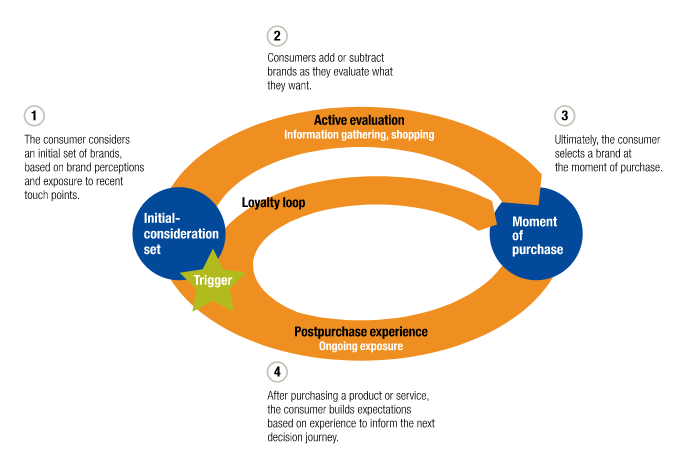
The New Customer Decision Journey, Image Credit: McKinsey & Co.
Step 1: Initial Consideration Set is where customers begin to get to know a brand through Brand Perception, which is more than just Brand Awareness. It involves a deeper understanding; for instance, if you are considering buying cosmetics from Brand A, you should not only know what Brand A sells but also understand how its products are superior to others.
Step 2: Active Evaluation is the phase where customers start gathering information to filter which brand to choose. During this stage, customers tend to think more critically, and they are easily distracted by various media, including Social Media, Websites, and Ads.
Step 3: Moment of Purchase is the crucial point where customers decide to make a purchase. At this stage, you may notice that the steps have decreased because the peak moment occurs afterward.
Step 4: Post-purchase Experience is where customers begin to evaluate whether they will buy again. If their experience is not satisfactory, they will have to start back at Step 1, meaning these customers do not exhibit loyalty. However, if they have a good experience, it leads to a Loyalty Loop, where they will purchase again without needing to think or compare.
Fewer Steps, but Harder to Buy
Have you noticed that the decision-making process for customers has shortened? It may seem like customers are deciding quickly, but if you focus on the details of each step, you will find that customers are gathering a lot of information before making a purchase. Therefore, if you want to be a brand that stays in the minds of consumers or becomes their Top of Mind, provide them with as much information as possible. Nowadays, customers can easily access information at their fingertips, and even when they are at the product shelf, they can still change their minds.
Making a Sale Doesn’t Mean Winning
From the final step, the Post-purchase Experience, it is evident that if customers are not in the Loyalty Loop, they will start evaluating your brand from Step 1 again. This means that just because customers make a purchase does not guarantee they will buy again next time if you cannot create a good experience. They will continuously seek out better brands to replace yours. For example, many women do not stick to just one cosmetics brand; even after making a purchase, they are always looking for other options that they believe will be "better."
While this may not be the only model of the Consumer Journey, there are many other Consumer Journeys in the marketing world that illustrate the complexity of consumers. Each product's Consumer Journey is unique. It is the marketer's responsibility to determine how to effectively reach the Consumer Journey of their customers. Today, it must be acknowledged that the business world is becoming increasingly challenging and changing rapidly. "Understanding customers" is the only way to survive. No matter how large a company is, if it does not adapt to the changing world, it can easily fade away with its outdated business model. Marketers must ask themselves, "Do you understand your customers today?" - TERRABKK
Article by: TerraBKK Investment Tips
TerraBKK Find Good, Valuable, Affordable Homes