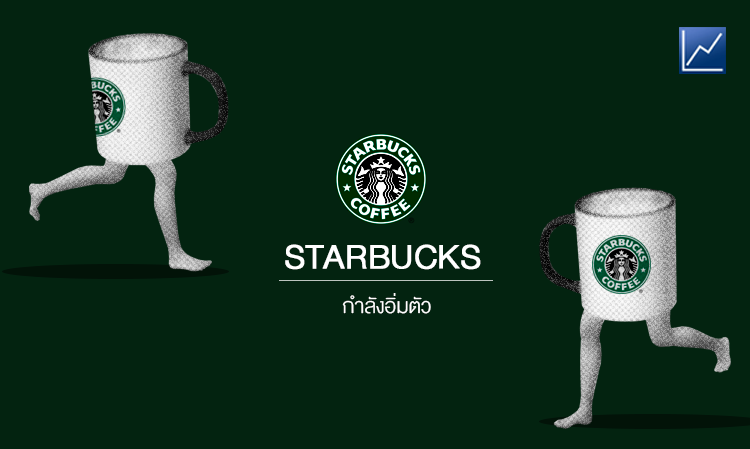
STARBUCKS is Reaching Saturation
STARBUCKS is currently facing slower growth than the market anticipated, and the company admits it is under significant pressure from digital disruption.
Currently, there are about 27,000 STARBUCKS locations in 75 countries, serving approximately 90 million customers worldwide each week. The company has experienced remarkable growth in the past, making it the second-largest restaurant chain in the world, behind McDonald's.
However, every party may eventually come to an end...
In the last quarter, STARBUCKS' sales in the U.S. grew by only 5%, primarily due to price increases rather than an increase in the number of drinks sold. It seems the company no longer expects growth in America, with its hopes now resting on China, a country that traditionally consumed tea rather than coffee.
Initially, STARBUCKS operated in China through a 50% stake in East China, with the other half owned by Taiwan's Uni-President.
Today, the company is seeking to buy out the remaining shares from the Taiwanese company to fully operate in China, agreeing to pay as much as 43 billion baht for the remaining stake.
At the same time, STARBUCKS will sell 50% of its shares in Taiwan for 5.8 billion baht to Uni-President.
This means that STARBUCKS is willing to abandon its business in Taiwan and focus on the Chinese market, which appears to have more room for growth.
STARBUCKS is Focusing...
STARBUCKS acknowledges concerns about retail industry disruption, which most American retailers are facing due to decreased foot traffic in malls, leading to declining sales and profitability. As a result, STARBUCKS must now focus on markets with potential for growth and concentrate on its core business.
STARBUCKS is Selling Its Tea Business...
In 2012, STARBUCKS acquired Teavana, a tea beverage retailer, for as much as 20 billion baht. However, the problem is that most of these stores are located in malls, where foot traffic has decreased, and the business has become unprofitable.
What was once a multi-billion baht business may now be worth nothing, as STARBUCKS announced it will close all 378 Teavana locations.
Competitors of STARBUCKS are Emerging...
Meanwhile, in developed countries, new café-style coffee shops are emerging as alternatives for consumers.
During my recent holiday in South Korea, I found new coffee shops popping up all over the city, with an ambiance just as inviting as STARBUCKS.Interestingly, after exploring, I noticed that STARBUCKS had fewer customers than some lesser-known coffee shops, possibly because every STARBUCKS location follows a similar format, unlike local coffee shops that offer unique menus and distinct decor.
Back in Thailand, while STARBUCKS may currently lead the coffee shop market, it is uncertain whether new coffee shop operators with appealing decor and flavors that satisfy consumers (which we are starting to see) will come in and capture STARBUCKS' existing customer base.
STARBUCKS Shares Underperforming...
Historically, STARBUCKS shares have always traded at a premium due to the company's strong brand. However, the market is now concerned that STARBUCKS may not grow as it did in the past. As a result, after announcing its earnings, STARBUCKS shares fell by 9.2% in a single day.
STARBUCKS is listed on the Nasdaq. Anyone who bought STARBUCKS shares at the beginning of the year has seen a loss of -2.7%, in stark contrast to the Nasdaq index, which has risen by 18.4% since the start of the year.
Moreover, anyone who purchased STARBUCKS shares two years ago has yet to see a profit, as the stock price has dropped by -7.0% compared to two years ago.
Ultimately, it remains uncertain whether STARBUCKS has reached saturation, but it is clear that the stock price of STARBUCKS likely peaked two years ago.
Thank you for the information from longtunman.com