Will it be another 50 years or 1,000 years? How long have Thai people really been waiting for public transportation?
The buses never arrive on time, and sometimes two come at once. The vans drive fast without caring about passenger safety. And taxis? Don't even get me started. They spend all day swaying while refueling. The skytrain is overcrowded, and by the time you exchange coins to buy a ticket, your legs are cramping up.
Oh, when will Bangkok finally develop its public transportation system?
It's not just Bangkok; even provinces in Thailand lack a truly concrete public transportation system. So, what has our country developed over the years? TerraBKK will take you back to the era of King Heaw, exploring the evolution of infrastructure and public transportation in Thailand. How long have we been waiting since that time, and did those who waited back then pass away before they could use it?
The Dvaravati Era: The Beginning of Urban Development
Thailand began establishing communities and became an important center of civilization in Southeast Asia. During the Dvaravati era, urban planning started to take shape. The city layouts were rectangular, circular, and oval, with moats dug for water management and strategies for warfare. Irrigation systems for agriculture were also initiated, with one of the archaeological sites indicating this being Phu Kraba National Park, where stones were arranged and earth was dug to show coexistence with nature.

The Sukhothai Kingdom (1238-1583)
We know that during the Sukhothai era, the invention of writing accelerated development. This period was influenced by the Khmer art and culture of Lopburi, using stones to build bridges, planning cities, and constructing dams, notably the Phra Ruang Road, which stretches 123 kilometers from Sukhothai to Si Satchanalai. The irrigation system became more evident with the construction of reservoirs and dams.

The Ayutthaya Period (1893-2310)
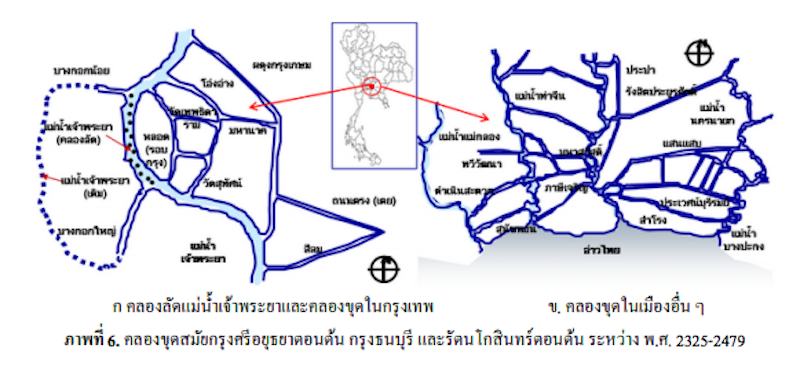
Ayutthaya was a period of long, intense, and tumultuous history, as seen in many films. The political landscape was strong and frequently changing. A significant infrastructure development was the excavation of canals to shortcut the Chao Phraya River between 1534-1547, which included surveying and constructing roads leading to Phra Phutthabat and digging canals connecting Khlong Khok Kham with the Tha Chin River (Mahachai Canal), leading to the present-day Tha Chalom and Mahachai. Additionally, trade flourished, religion spread, buildings were planned, walls were constructed, and a water supply system was established.
The Early Rattanakosin Era
Travel by boat remained prevalent, with canals being dug around Rattanakosin. After a major flood in 1831, over 100 new canals were excavated in Bangkok. Between 1851-1868, scientific and technological advancements increased, leading to the introduction of steamships, lighthouses, and navigable waterways, along with the first maritime laws. New technology was also applied to road construction, including Chareon Krung Road, Bamrung Muang Road, and Feung Nakorn Road.
The Mid Rattanakosin Era (2411 – 2453)
This period marked the serious beginning of new infrastructure development, characterized by larger scales and more complex technologies. The tram system was introduced, with a joint venture for tram services established in 1905 by the Thai Tram Company Limited, which received the concession. This was the first clear mass transit system in Bangkok and Thailand, along with the construction of several roads in the Phra Nakhon area, Yaowarat, and Si Ayutthaya. Private companies also constructed roads in the Silom-Sathorn area. In 1891, Thai people could proudly say they began constructing the first railway, which connected Bangkok to Nakhon Ratchasima, and established the Royal Railway Department (now the State Railway of Thailand), along with several buildings designed in European styles.
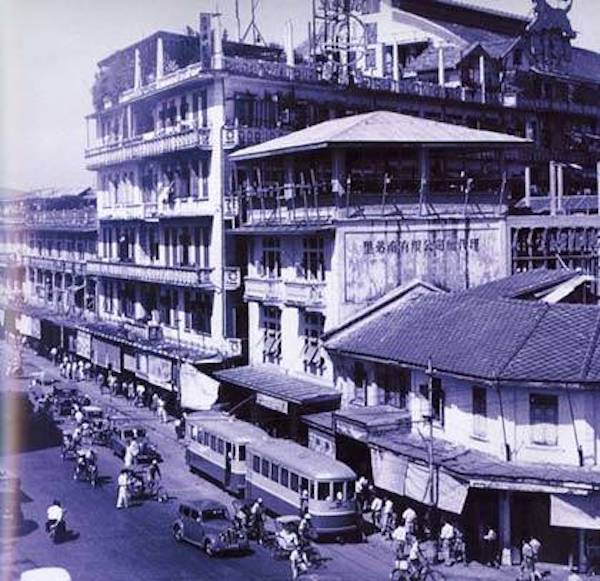
Image from: https://www.thairath.co.th/
The Transitional Era to Present
After several changes in concession holders, the role of trams began to decline as more affluent citizens, such as government officials and wealthy merchants, started owning their own cars (this trend emerged after World War II). Importantly, public transportation services like taxis and buses began, with Nai Lert Company Limited starting the first bus service around 1916, followed by other companies entering the market in 1933, totaling 28 companies. The first transportation law was enacted in 1954 to regulate the industry.
However, despite the regulations and numerous operators, quality did not necessarily improve. In recent years, competition for routes intensified, and service standards varied. There was a free-for-all in operations (this issue sounds familiar, doesn't it?). Consequently, in 1975, M.R. Kukrit Pramoj, who was then Prime Minister, decided to consolidate bus operations in Bangkok into a single company named Mahakarn Transport Company Limited.
Later, in 1984, the Cabinet began constructing various public transportation systems, including elevated roads, expressways, and railways.
After the introduction of buses, expressways, and elevated roads, Bangkok continued to develop its transportation system, leading to increased traffic congestion as there were only roads for cars, and the bus system gained a reputation for poor service. We had to wait 14 years before the Cabinet assigned the design of the public transportation system in 1998, and the Public Mass Transit Authority of Thailand Act was enacted in 2000. After six years, we finally had our first operational skytrain, which was the Bangkok Metropolitan Skytrain, or the subway, in 2004.
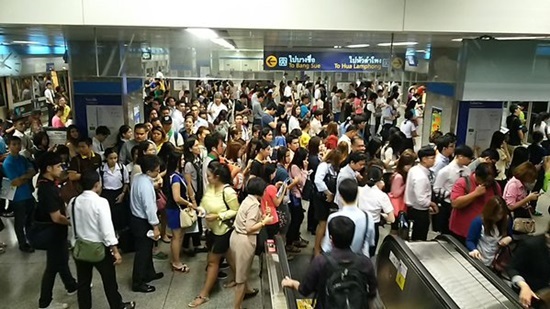
Image from: https://hilight.kapook.com
Thirteen years later, we now have five operational skytrain lines with 79 stations, accommodating approximately 1.2 million passengers daily. And we will wait another 10 years until all lines are operational around Bangkok.
If we count from the date we had our first tram in 1905 until the first skytrain service in 2004, we waited 99 years for a concrete public transportation system! And we will wait another 10 years for a comprehensive skytrain system in Bangkok. As for the provinces, there are signs of public transportation development in major cities, but who knows if it will take another 50 years or 1,000 years before we have public transportation comparable to developed countries.
Article by: TerraBKK Investment Tips
TerraBKK: Find good, valuable, and affordable homes