8 Signs That Just Knowing Can Help You Read People's Minds
The Thai proverb "You may know the face but not the heart" remains a painful truth. No matter how well you can hide your emotions without showing them through your facial expressions, tone of voice, or words, ultimately, body language often reveals the truth you are trying to conceal.
Research from the University of California, Los Angeles, has shown that in human communication, only 7% is based on the words spoken, while 38% comes from the tone of voice, and a significant 55% is derived from body language.
Therefore, if you don’t want others to discover the secrets in your heart or misunderstand you due to habitual body language, or if you want to learn how to read body language, try observing these 8 signs from your conversation partner.
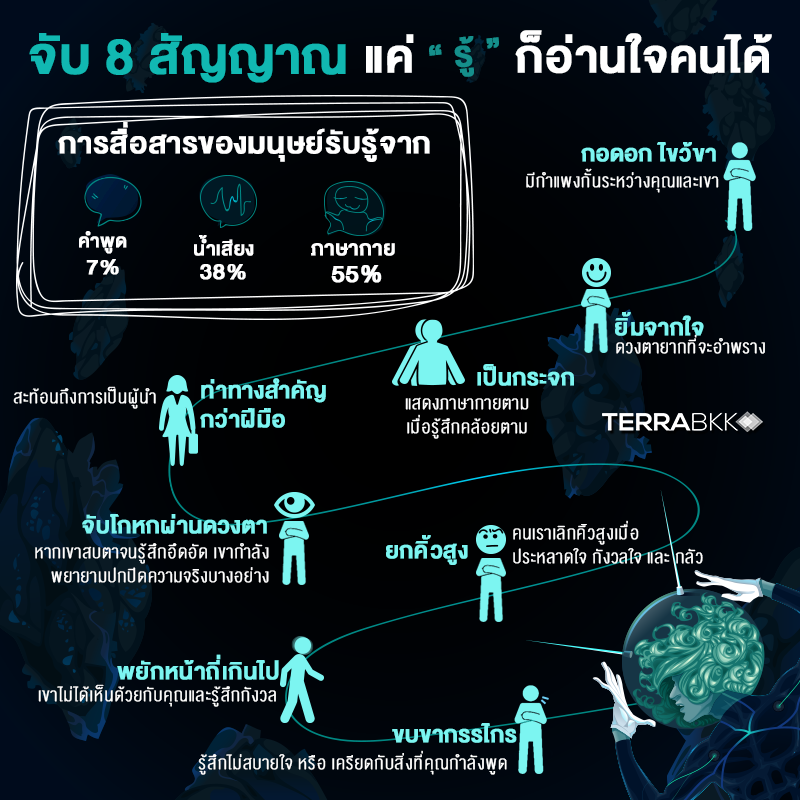
1. Arms Crossed and Legs Crossed If he/she often adopts a crossed-arms or crossed-legs posture, know that deep down, they are building a wall between you and them. One study that sheds light on this body language involved recording 2,000 negotiation pairs, revealing that negotiations where one party crossed their legs ended in failure. Psychologically, this behavior signals an unconscious attempt to protect oneself from what is in front of them.
2. A Genuine Smile Despite Wrinkles No matter how sad you are, you can still force a smile, but sad eyes are hard to disguise. One technique to determine if the other party's smile is genuine is to look beyond the lips to the entire face. If smiling causes wrinkles to appear, that’s a 100% genuine smile.
3. Mirroring Your Actions Don’t be annoyed if you notice your conversation partner mimicking your body language. This mirroring behavior often occurs unconsciously when someone feels in sync with you. So, if your partner displays this behavior while you’re persuading or negotiating, you can smile inside knowing that you have a significant advantage in the discussion.
4. Body Language Matters More Than Skill Have you ever wondered why some people leave a lasting impression the moment they enter a meeting room, while others are judged as lacking skill from the first step? This is all due to the body language they exhibit. If you walk confidently with your chest out and shoulders back, it reflects the character of a self-assured leader.
5. Detecting Lies Through the Eyes Often, we catch someone lying by their avoidance of eye contact, but this method may no longer be effective as many have learned to mask their deceit by maintaining eye contact. Therefore, the way to detect lies through the eyes has changed. You should observe if the person is trying too hard to maintain eye contact or if they stare at you for more than 10 seconds. Studies show that, on average, Americans maintain eye contact for only 7-10 seconds. If you encounter someone who tries to hold your gaze for longer than 10 seconds or until it feels uncomfortable, assume they might be trying to cover up some truth from you.
6. Raised Eyebrows There are only three feelings that cause the brain to signal a person to raise their eyebrows: surprise, anxiety, and fear. Therefore, if your conversation partner raises their eyebrows while discussing a topic that doesn’t fall into these three categories, you should start reconsidering what they might be thinking.
7. Excessive Nodding If you notice that your conversation partner is nodding excessively in agreement with what you’re saying, know that this is a sign that they may not genuinely agree with you but are feeling anxious about what you might think of them or whether they can follow your instructions.
8. Clenching Jaw A simple way to observe if the other party is feeling uncomfortable or stressed about what you’re discussing is if they are clenching their jaw, causing tension in their neck and furrowing their forehead. If you notice these signs, know that even if their words seem calm, their mind is likely in turmoil.
Source: www.talentsmart.com
Article by: TerraBKK Knowledge Base
TerraBKK: Find Good, Affordable Homes