
Management System: BRING THE NEXT BIG THINGS
Technology and digital systems are being discussed more than ever. There is a consensus that these are crucial factors driving success in business and innovation today, especially in startup businesses and various sharing economy ventures. However, one aspect that many may not have a clear picture of is the outcome of the integration between technology and these business models, particularly in the real estate sector, which is a large industry and plays a significant role in global GDP.
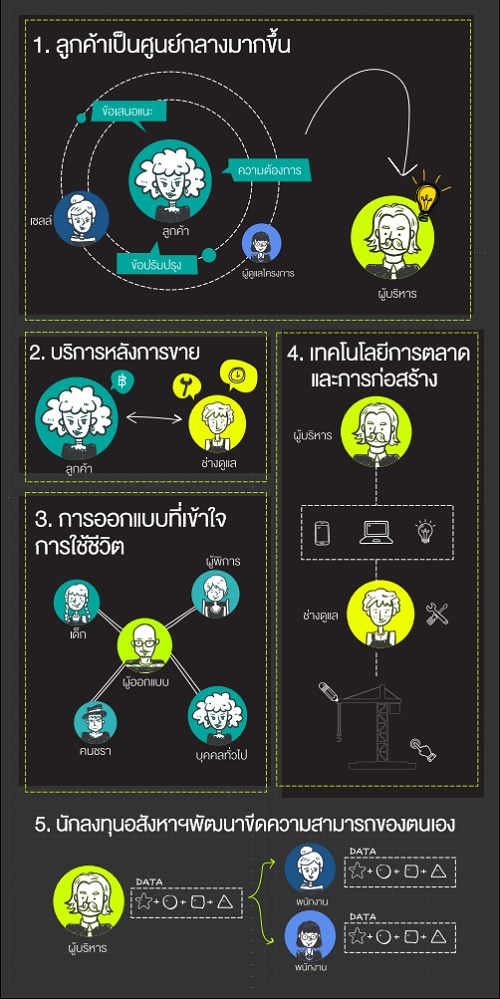
Subbu Narayanswamy, a senior shareholder at the global real estate leader McKinsey & Company, revealed survey results regarding future trends in the real estate business. The majority of voices echoed five key trends:
1. Customer-centricity will become increasingly evident and important.
2. After-sales service in terms of care and delivery is what customers are looking for.
3. Design that understands lifestyle patterns and sustainability.
4. Marketing and construction technologies will become essential in business operations.
5. Real estate investors will begin to clearly expand their capabilities and those of their organizations.
All these trends seem to indicate that the real estate industry will advance further than before. However, the dimensions of business model development certainly do not stop here.
The decimal numbers added after nouns to hint at development paths with technology, such as Thailand 4.0, are becoming more familiar. In the real estate business, this term has also been used for a long time. Research from the University of Oxford on PropTech 3.0: the future of real estate indicates that the history of technology in real estate development, or PropTech (Property Technology), began between 1980 and 2000 in London, England, referred to as PropTech 1.0, which involved property market analysis. The program for market analysis named PC-driven Property Research was developed for distribution in 1982.
Subsequently, more programs were developed to assist in the construction industry, especially in engineering and architecture, notably the AutoCAD program from Autodesk, which transformed the working methods in construction and design, allowing for reduced time and increased accuracy up to the present day. Later, various software developments expanded further. In 1984, CoStar, a program for data analysis and marketing for real estate, was launched in the United States and expanded into Canada, the UK, France, Germany, and Spain. CoStar became a market leader in data analysis software comparable to Microsoft Excel. The era of PropTech 1.0 began to slow down during the Internet Boom and transitioned into the era of PropTech 2.0, the new wave of the present.
In this era, the influence of startup growth has become a driving factor for PropTech 2.0, with key components similar to other startups, namely the assembly of information sources, which include venture capital, accelerators, and data researchers. Typically, it starts with selling business ideas in exchange for development funding, initially ranging from $250,000 to $2,000,000 in Series A, and from $2,000,000 to $15,000,000 in Series B and C. If the business grows beyond that, there is often a goal to scale through acquisitions and enter the stock market with major supporters being recognized venture capital and accelerators such as 500 StartUps and Y Combinator. In the research sector, entities like CBRE, CBinsight, or MIT often take on the role of hosting seminars on these types of businesses.
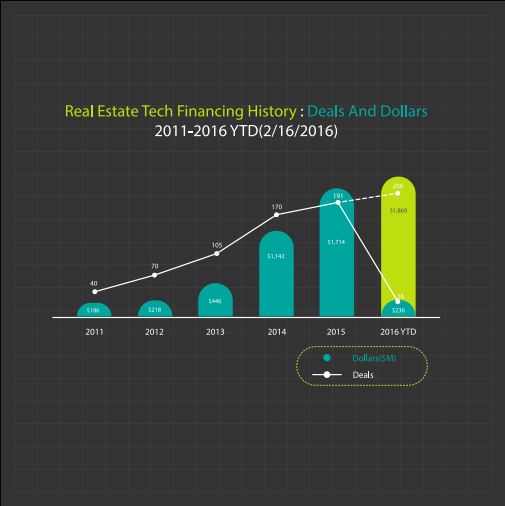
According to a survey by CB Insights, in 2012, nearly $6.4 billion was raised in PropTech from various funding groups, including brokers, investors, owners, and real estate developers. By late 2016, Venture Scanner announced that funding in PropTech reached $28 billion, indicating that real estate investors and developers worldwide are becoming increasingly aware of the development of real estate technology and fear being left behind. The University of Oxford predicts that there will be over 2,000 PropTech companies in 2017, with 60% expected to have improved funding, with some businesses raising up to $300-500 million. Business models classified under PropTech include property registration and search services, management and leasing software, marketing services, investment and crowdfunding, real estate data services, property appraisal and analysis, housing loans, real estate brokerage, building and property management, and 3D Virtual or virtual property viewing, among others.
Management System: Bring The Next Big Things
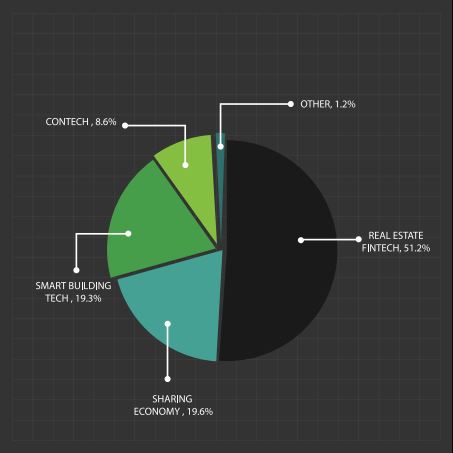
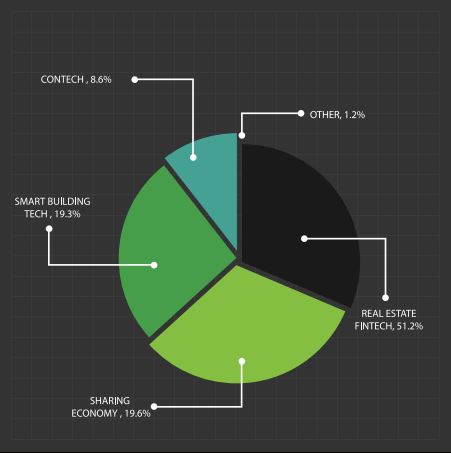
PiLabs, the largest PropTech-focused accelerator in the UK, has created a business platform related to PropTech, divided into four areas: Real Estate FinTech, which involves control, management, and real estate services; Contech, which focuses on construction management techniques; Smart Building, which deals with management and repairs; and Sharing Economy, which expands rental space. It was found that Real Estate has the largest share, while Smart Building and Sharing Economy are closely matched.
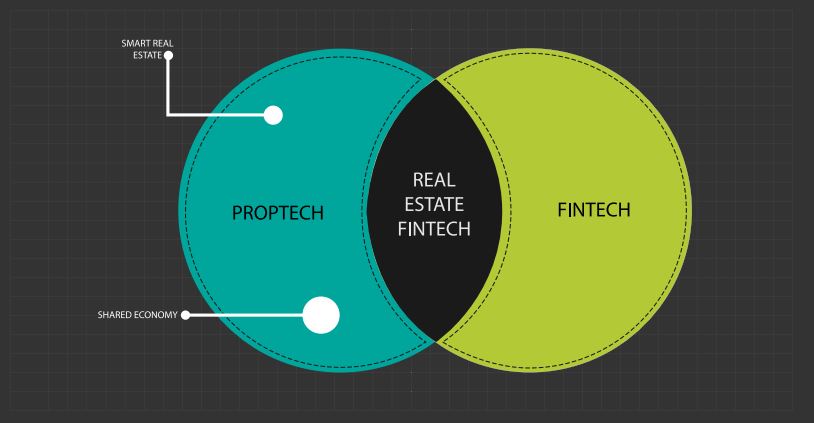
When analyzing the growth figures of each business type, it is found that the Sharing Economy sector has a growth rate equal to that of Real Estate FinTech. PiLabs provides a breakdown of PropTech and Fintech, indicating that PropTech overlaps with FinTech, meaning that the scope of business technology, whether PropTech, Fintech, ConTech, or others, is interconnected, allowing for a clearer picture of PropTech. Moreover, it has relationships with other tech businesses in construction, repair, management, and finance. This imagery clearly reinforces how the universe of technology businesses is expanding beyond boundaries and poses a significant challenge regarding the future direction.
MASTER BUILDER TRANSFORMED
In an era when humans began to learn construction and sought to challenge God by building the Tower of Babel, aiming to reach heaven through height, humanity's arrogance was curtailed by a lack of understanding in communication, rendering the Tower of Babel merely an unfinished ruin. Subsequently, humans learned various construction techniques, whether wood, steel, or concrete, collaborating in a One for all, All for One manner, known as Master Builder. This continued until the Industrial Revolution, when construction reached its peak, and Master Builders disappeared from the world as the US Capital Dome was completed in 1800, separating the work between architects and construction teams. The working methods in construction began to change; however, research indicated that construction efficiency continued to decline due to the disjointed work of many people, leading to significant human errors, particularly due to unequal access to information. This prompted the construction industry to reconsider the working model of the Master Builder, and BIM emerged as the solution to this problem. BIM, or Building Information Modeling, is a 3D modeling system for managing building construction and projects, clarifying engineering systems, reducing human process steps, and creating a robust data foundation to manage throughout the building lifecycle.
What makes BIM akin to Master Builder is its ability to connect data between project owners, designers, and contractors throughout all construction phases, displaying results in 3D on computer systems without designers needing to work on paper anymore. Additionally, BIM can store data for every construction component, including doors, windows, columns, beams, stairs, or even bricks hidden within walls, allowing for reduced inspection and repair steps when damage occurs. The strength of BIM lies in being a vast data-based system that helps reduce time and budget losses, increases accuracy in data transfer, and importantly alleviates human error, making BIM a widely adopted model for applying construction data globally.
Data Shifts City
As data becomes a crucial weapon for advancement in the technology era, it is evident that every startup is diligently gathering data to produce products and services that address the pain points of the majority. These efforts are the source of the remarkable success of startups. Moreover, data is also vital for driving significant urban development.
After Hurricane Katrina caused extensive damage across the United States, the citizens of New Orleans established The Greater New Orleans Community Data Center to gather information from various sources to assist the public promptly. After the storm subsided, New Orleans, known for its high crime rates, addressed the issue by raising funds from citizens through the French Quarter Task Force, an application that allows residents to report emergencies or suspicious activities more conveniently and quickly than calling 911.
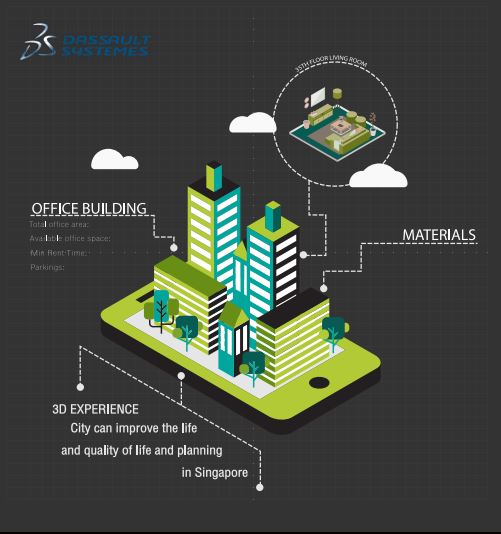
What is astonishing is what is happening in Asia. In June 2015, the Singapore government collaborated with French company Dassault Systemes to create 3D Virtual imagery of the entire country! The three-dimensional images, along with various data from Singapore, were published on YouTube in July 2016, just over a year later. The significance of creating 3D Virtual in Singapore is profound in terms of developing a national data repository that will not only address problems or develop in one specific area but will prepare for simultaneous development across the entire city, including data on traffic volume, infrastructure, public health, safety, construction, real estate, and many other unimaginable aspects.
Imagine just clicking on a room in a condominium, and you can see the position of columns and all the interior materials in detail. This is the enviable advantage of those who hold the universe of data in their hands. Technology not only drives business growth significantly but also propels national development. Like a beautiful jigsaw puzzle, when all the pieces come together, they create a complete picture without leaving any piece behind. This is akin to the collaboration of power and technological innovation across various sectors.
To develop Thailand without leaving anyone behind
Thanks for the information from: HINT MAGAZINE